
WORKFLOW AUTOMATION
The agent reads an invoice, checks policy, updates the CRM, and triggers an approval.
Who controls its authority before it acts?
- authority
- tool permissions
- approval gates
- evidence
 Sheet 00 / 05
ADG is EC-Council's open AI governance framework for the agentic era. 12 control families, 180+ controls, 720+ requirements, mapped to 90 standards and regulations.
Mapped to
90
standards and regulations
Not a rulebook.An operating model.
An AI governance framework is the set of policies, controls, and accountability chains that decide how an organization builds, ships, and watches its AI: who signs off before a model goes live, what gets checked before and after, and how any of it is proven to a regulator or the board. ADG makes that continuous: controls run and evidence accumulates on every run, not once a year.
Policy
Who may approve a use case, and who is accountable when the system acts.
Controls
12 control families, 180+ controls, each with the requirements that prove it.
Evidence
Proof that accumulates at every stage, so an audit is a review, not an investigation.
Control families
12
Library controls
180+
Standards & regulations mapped
90
90 in the crosswalk
Open framework · no registration
Free
Every agent will acton your behalf.
Most organizations already run agents they cannot list, owned by people they cannot name. Each one reads, decides, and acts. The question is never whether it can. It is who controls it before it does.
WORKFLOW AUTOMATION
The agent reads an invoice, checks policy, updates the CRM, and triggers an approval.
CUSTOMER ADVISORY
The agent advises a customer, draws on sensitive context, and speaks for your organization.
SOFTWARE ENGINEERING
The agent writes code, tests changes, and prepares systems for release.
MARKETING & CONTENT OPERATIONS
The agent creates, reviews, and prepares business content for publication.
Governance is not the same as security. ADG does not make you choose.
Adopt and Govern set the policy. Defend enforces it. Govern proves it. One operating model, one body of evidence.
ADG works in tandem. The first, second and third lines are roles, not silos: each one reads and writes the same evidence repository, so nothing is re-done, nothing is reconstructed, and the board sees one continuous record instead of three reports that disagree.
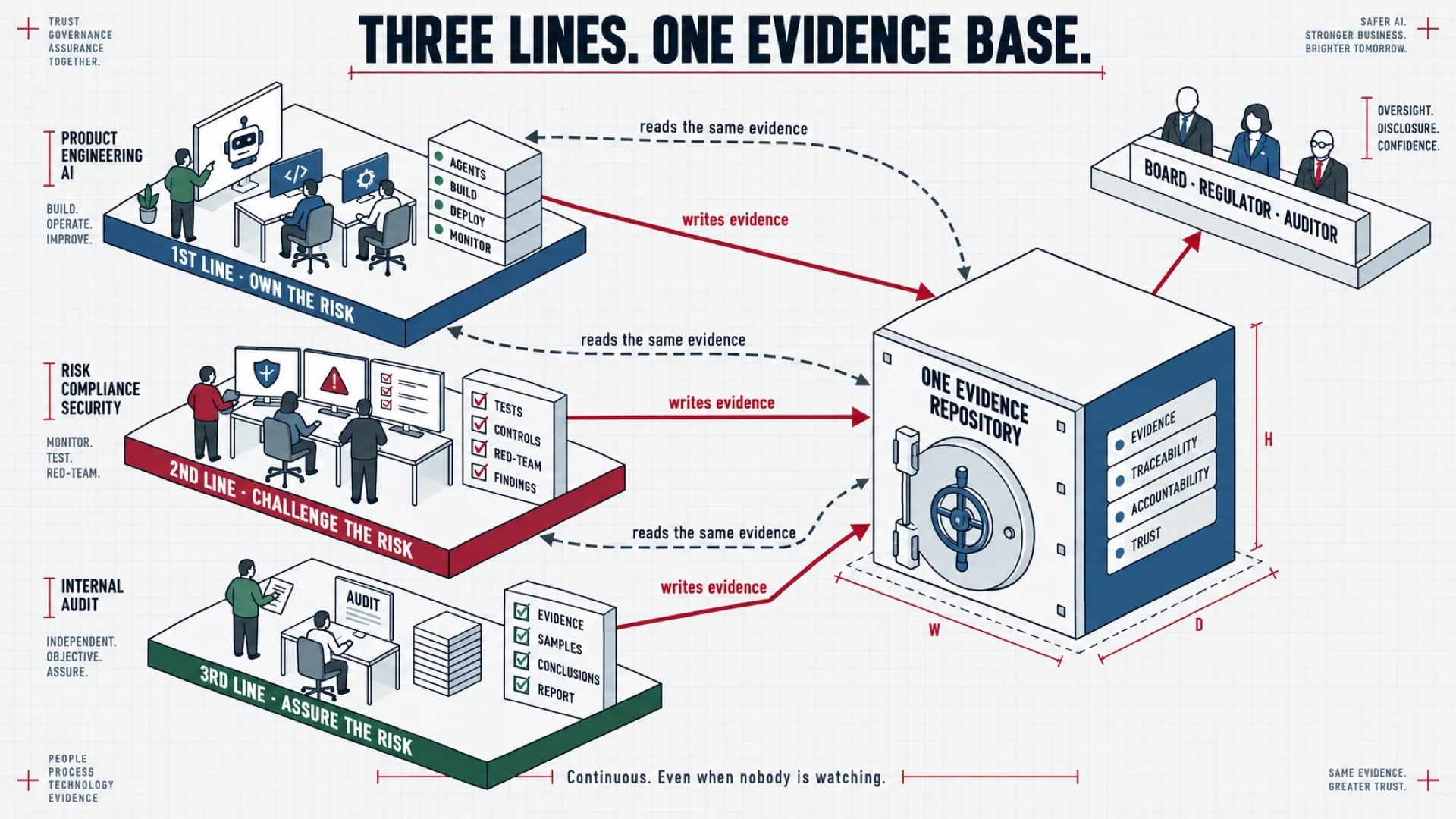
| Line | Who | Activities | Inputs | Outputs |
|---|---|---|---|---|
| 1st · Own the risk | Product, engineering, AI teams | Build, deploy and operate agents; run the controls | Use-case intake, policies, the control library | Control evidence, runtime logs, incident reports |
| 2nd · Challenge the risk | Risk, compliance, security | Set policy, monitor, test, red-team, advise | 1st-line evidence, the regulatory crosswalk | Findings, exceptions, attestations |
| 3rd · Assure the risk | Internal audit | Independent assurance to the board | 1st + 2nd line evidence, same repository | Audit opinion, board evidence pack |
| All three lines write to and read from one repository. Evidence is generated on every run, not reconstructed at audit time. | ||||
12 families.180+ controls.
Three pillars, one control set. Adopt decides what may run. Defend keeps it inside its envelope at runtime. Govern proves both to the people who ask.
Decides what may run.
Keeps it inside its envelope at runtime.
Proves both to the people who ask.
| Family | Controls | Pillar |
|---|---|---|
| Design & Requirements | 6 | Adopt |
| Data | 19 | Adopt |
| Build & Integration | 29 | Adopt |
| Deployment & Change | 7 | Adopt |
| Evaluation & Red Teaming | 21 | Defend |
| Runtime Defense & Monitoring | 25 | Defend |
| Incident Response & Forensics | 11 | Defend |
| Third-Party & Supply Chain | 7 | Defend |
| Accountability & Roles | 9 | Govern |
| Inventory & Risk | 5 | Govern |
| Transparency & Interested Parties | 16 | Govern |
| Oversight & Review | 23 | Govern |
| 12 families | 180+ | 3 pillars |
Evidence once.Answer many.
Regulators, auditors, and security teams ask the same questions in different dialects. ADG answers once: 180+ controls crosswalked to 90 standards, regulations, and threat catalogs across six regions.
90
standards & regulations, one control set
Figure beside each name = ADG controls mapped · underlined = well-known standard · 90 entries across six regions
Global30 entries
United States24 entries
Asia-Pacific19 entries
Middle East8 entries
Europe7 entries
Other2 entries
Start whereyou are.
Two ways in, depending on who you are. Both take minutes, and both hand you something you can act on today.
Assess Your Organization
CISO · CIO · risk · board
You already run agents. The assessment benchmarks your organization against all 12 families, scores each one, and hands you a 30/60/90-day roadmap with named owners. Board-grade, not a slide deck.
Start Now →For companies: 12 families scored, a 30/60/90-day roadmap.
Assess Your Skills
Security · AI · engineering · audit
Pick a pillar. Just 10 minutes, real scenarios, no registration wall. Pass it, and you earn the ADG pillar badge you can put next to your name today.
Start Now →For you: 10 minutes, one pillar, a badge with your name on it.
Scope an engagement: Discover → Analyze → Report → Transform.
An AI governance framework is often mistaken for a rulebook that is consulted only after an incident. In practice, it is the set of policies, controls, and accountability chains that determine how an organization builds, ships, and monitors its AI systems: who signs off before a model goes live, what must be checked before and after deployment, and how compliance is demonstrated to a regulator or the board. Because AI evolves rapidly, an effective AI governance framework must be a flexible, living document focused on robust implementation rather than compliance formalities.
ADG (Adopt, Defend, Govern) is a free, open AI governance framework developed by EC-Council in collaboration with its AI Advisory Board of leaders from around the world. Many AI governance frameworks focus primarily on policy. ADG also includes a dedicated Defend pillar for the technical side of AI security, so governance and security teams work from the same evidence instead of running two disconnected programs.
Not quite, although the two terms are often used interchangeably. AI governance is the policy side: it determines who may approve a use case and how that use case is audited. AI security is the technical side: it defends against threats specific to AI, such as prompt injection and model extraction. ADG does not make you choose between them. Adopt and Govern set the policy, Defend enforces it, and Govern proves it. Together, they form a single operating model rather than two teams working in isolation.
ADG's 180+ controls are crosswalked to 90 standards, regulations, and threat catalogs, including the NIST AI Risk Management Framework (AI RMF), ISO/IEC 42001, and the EU AI Act. New national and sector regulations will be added as they emerge. As a result, audit and compliance teams work from one control set instead of maintaining a separate compliance program for each standard.
ADG is built for three audiences:
Start with Assess Your Organization, which benchmarks your organization against ADG's 12 control families and provides a 30/60/90-day roadmap to work from.
EC-Council Global Services leads the framework, supported by a 38-member AI Advisory Board of CISOs, CIOs, and AI engineering leaders from organizations such as Microsoft, Salesforce, JPMorgan Chase, and Citi. Every version is published openly (currently v2.0), and community feedback shapes each new release.
Yes. ADG is free to use; it is not a free trial. As an open AI governance framework, all of its components are free to access and implement: the 12 control families and 180+ controls, the regulatory crosswalks, the white paper, and the self-assessment tools. EC-Council stewards ADG through its AI Advisory Board rather than selling it as a licensed product.