Continuous skill development is critical in cybersecurity. Structured learning, practical labs, and exposure to advanced attack techniques empower professionals to elevate their technical proficiency and stay ahead in an ever-changing threat landscape. To understanding the practical value of the Certified Ethical Hacker (CEH) Certification program in continuous skill development, EC-Council interviewed incident response leader Don Warden for his real-world insights as an experienced cybersecurity professional. The Interview highlights how CEH enhances technical skills, improves career opportunities, strengthens offensive security knowledge, and complements modern practices, including the integration of AI tools into ethical hacking and threat detection.
What motivated you to pursue the CEH certification?
I pursued the CEH certification to gain stronger recognition in the cybersecurity field and deepen my understanding of ethical hacking techniques. I wanted practical insights into real-world attack methods to enhance my project opportunities and support my professional growth. A primary motivator was CEH’s structured learning path, which covers both fundamental and advanced concepts that align well with what I see happening in the industry.

Having CEH on my résumé significantly strengthened my position during rate negotiations. It validates my expertise and signals readiness for more challenging roles.
Today, I work in my dream role as a Cyber Incident Commander, where each day presents new challenges and keeps my skills sharp.
What aspects of the CEH program were most valuable to you, and how did they support your professional development?
The hands-on labs were particularly valuable. They allowed me to simulate real-world hacking scenarios and apply concepts practically. The course was well-structured and provided deep insights into various attack vectors. Knowledgeable instructors offered practical guidance, and the program resources gave me the confidence to apply these skills in real projects that I still work on today.
How widely recognized and respected is the CEH certification in the cybersecurity industry? How does your organization view it?
CEH is highly respected and is considered a benchmark for ethical hacking skills. It is widely recognized across various industries, including IT, finance, and government sectors. This recognition enhances its credibility for cybersecurity professionals.
CEH stands out by offering a strong balance of practical and theoretical knowledge, primarily through its emphasis on real-world hacking techniques and methodologies.
For career advancement, CEH provided foundational skills that were easier to apply immediately compared to my other certifications.
Have you completed Security+? If so, how does CEH differ from Security+ and similar certifications?
While I have not completed Security+, I recognize it as a strong introduction to general security concepts. CEH, however, goes much deeper into hacking methodologies and practical offensive techniques. Security+ focuses on broad security principles, while CEH emphasizes the hands-on tools and methods used by penetration testers and ethical hackers in real-world environments.
How critical is CEH training for career development in cybersecurity or IT?
CEH is extremely valuable for anyone aiming to advance in cybersecurity. It equips professionals with practical skills that can be applied immediately, even within broader IT roles. As cybersecurity becomes indispensable, especially for IT administrators and system engineers,
CEH provides essential capabilities that support both career growth and organizational security.
Do you think IT professionals should pursue the CEH certification? Why is it significant in today’s landscape?
With today’s highly interconnected systems, IT professionals require a comprehensive understanding of cybersecurity to effectively manage and secure networks and infrastructure. Completing the CEH gives them a clear advantage by enabling them to proactively identify and mitigate vulnerabilities rather than responding only after an incident occurs.
Tell us about your journey as a cybersecurity professional.
I began my career in IT as a Systems Administrator and later as a System Security Officer in the United States Navy. Over time, I developed a strong interest in cybersecurity, particularly after realizing the critical importance of security in managing infrastructure while running an managed service provider (MSP).
My transition into cybersecurity was driven by the desire to solve complex challenges and make a meaningful impact for my clients. My achievements include earning a Master of Science in Cybersecurity and Information Assurance, completing the CEH certification, and leading large-scale digital forensic and incident response cases.
Looking ahead, I aim to further enhance my expertise in threat detection and response, as well as prepare for emerging challenges driven by quantum computing and artificial intelligence.
How has the integration of AI tools and techniques enhanced your ethical hacking skills and efficiency in real-world scenarios?
AI tools have significantly improved my workflows by automating repetitive tasks such as vulnerability scanning and initial analysis. This allows me to focus on more complex work, such as exploit development. AI also improves clients’ threat detection capabilities by identifying patterns that traditional methods may overlook.
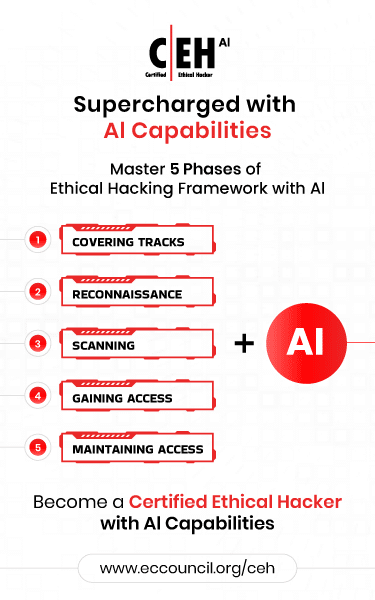
Can you share an experience where AI played a crucial role in any of the five phases of ethical hacking (e.g., reconnaissance)?
During the reconnaissance phase, I often use AI-powered tools to analyze large volumes of publicly available data. These tools help identify weak points in an organization’s infrastructure and predict potential attack vectors by correlating past attack patterns with newly discovered vulnerabilities.
What specific benefits have you seen from integrating AI-based skills learned in CEH into real-world ethical hacking tasks?
AI-based skills have enhanced my ability to automate scans and prioritize threats based on severity, saving a considerable amount of time and effort.
These tools also help in handling AI-driven attack systems by responding to threats in real-time and mitigating risks more effectively than manual methods alone.
Conclusion
The CEH certification remains a valuable asset for IT and cybersecurity professionals, providing practical, applicable skills that enhance both offensive and defensive capabilities. Combined with emerging AI-driven techniques, CEH equips professionals to face evolving threats with confidence, making it an essential credential in today’s rapidly advancing cybersecurity landscape.
About the Interviewee

Don Warden II
Director, Incident Response, Cybolt
Don Warden is a cybersecurity leader with over 30 years of experience in threat intelligence, digital forensics, and incident response. Holding advanced certifications and a Master’s in Cybersecurity, he advises organizations on risk mitigation, compliance, and AI-driven security strategies, ensuring resilience against ransomware, insider threats, and cyber extortion.