

2026 is shaping up to be a powerful year for a career reset.
Across industries, professionals are rethinking stability, growth, and future relevance. Automation, artificial intelligence (AI), and digital transformation are changing how we work, and in some cases, if roles exist at all. One field, however, continues to grow faster than the rest, unaffected by economic slowdowns and constantly hungry for talent: cybersecurity.
You do NOT need an IT background to build a successful cybersecurity career.
Cybersecurity today is where data science was 10 years ago—high growth, high pay, and low supply.
Industry estimates and studies show a massive global talent shortage in cybersecurity—historically measured in millions of open roles. For instance, Cybersecurity Ventures projected 3.5 million unfilled cybersecurity jobs through 2025.
More recent studies show different ways of counting the gap—the workforce size vs. the demand. The 2024 ISC2 Cybersecurity Workforce Study estimated the global cybersecurity workforce at about 5.5 million people, while still describing a multimillion supply-demand gap.
As per a 2025 KPMG Cybersecurity Survey, 53% of leaders cited a lack of qualified candidates as a high impact challenge, prompting higher compensation (49%), more internal training (49%), and more reliance on external partners (25%), including Managed Security Service Providers (MSSPs), to close critical gaps.
The late 1990s dot-com boom saw internet adoption explode, venture capital pour in, new roles appear overnight, and salaries and opportunity follow. Cybersecurity in the 2020s is seeing a similar demand surge, though with a different shape. Companies are investing heavily to protect digital assets; governments and militaries are prioritizing cyber readiness; and AI is reshaping both attack and defense, creating new roles and higher pay for skilled professionals.
The 2025 KPMG Cybersecurity Survey, which polled over 300 c-suite and senior security leaders, found that spending is already surging, with 98% reporting budget increases in the last 12 months. With 99% of companies planning to increase cyber budgets in the next few years, a majority (54%) expect significant increases of 6–10% as they brace for future threats.
Salaries vary by country, industry, role, and location. Below are sourced examples of what entry-level compensation looks like today:
United States: Information Security Analyst (median)
The U.S. Bureau of Labor Statistics (BLS) reported a median annual wage of $124,910 (May 2024) for Information Security Analysts. The lowest 10% earned less than $69,660, which can help frame entry-level ranges. (The median is the midpoint, so entry-level roles often sit below it, while experienced roles pull the median upward.)
United States: entry-level Analyst ranges
Aggregators of employer data show entry-level cybersecurity analyst salaries in the $62,000–80,000 range depending on location and employer. Glassdoor-linked notes and career guides often quote average entry-level figures around $70,000–74,000.
Training/provider guidance (EC-Council example)
EC-Council notes that typical entry-level roles can start at about $70,000 in some markets, with senior roles exceeding $200,000.
Takeaway: entry-level pay often falls in the low to mid $60,000–80,000 range in many high cost countries, with US tech hubs trending higher. Compensation typically rises quickly with experience and certifications, and senior and specialized roles commonly exceed 150,000.
Use BLS and platform data to refine expectations for your city/industry.
One of the biggest myths is that cybersecurity is only for engineers. In reality, diverse backgrounds strengthen security teams.
Cybersecurity needs people who understand human behavior, processes, industries, and risks—not just systems.
Cybersecurity is not built only on coding or system administration. It is built on risk, behavior, decision-making, investigation, communication, and process control—skills that exist far beyond IT.
Technical specialists build systems.
Security professionals manage risk, monitor threats, and respond.
Entry-level cybersecurity roles are designed to teach technical concepts gradually, without requiring prior IT experience.
Certifications from EC-Council intentionally start from concepts, not complexity.
EC-Council’s certification trainings like Certified Cybersecurity Technician (CCT) go beyond fundamentals by building strong hands-on technical skills. They are designed specifically for entry-level professionals, with emphasis on real-world tool usage and practical application.
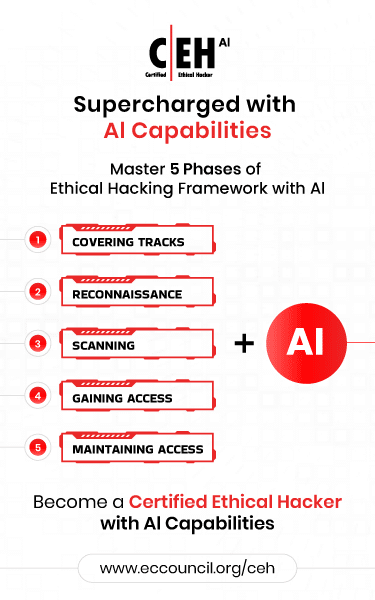
Globally recognized certifications like EC-Council’s Certified Ethical Hacker (CEH AI) develop core cybersecurity skills that apply across all security domains. They teach the hacker mindset, the five phases of ethical hacking, and how to apply each phase effectively using AI-driven techniques.
This bespoke learning structure makes cybersecurity accessible to non-IT professionals.
This is why professionals with no IT background can successfully transition within 8–12 months of structured learning.
A structured roadmap is essential. That is where globally recognized certifications from EC-Council come in.
These certifications are trusted because they are job-role focused, not theory-heavy.
Below is a roadmap to EC-Council certifications. You do not need an IT background, but you do need deliberate steps and some practical practice.
Awareness and basics – understanding the problem
Core defender mindset – monitoring and response
Understand attackers – legal hacking
Practical offensive skillset – deep testing
Digital forensics – evidence and investigation
Cloud and modern infrastructure security
Leadership and business alignment
Useful EC-Council roadmap and resources: EC-Council’s official career path and certification pages, including a downloadable roadmap PDF, chart certifications for job roles and experience levels.
Each of these roles aligns with the EC-Council certifications above, giving you a clear way to validate skills for employers. EC-Council job-role mappings can help you decide which certification to start with.
Your Experience
Job Roles / Careers
Job Roles
Careers
No Experience Required
1-2 years Basic Computer Knowledge
More than 2 years Networking Knowledge
Core cybersecurity knowledge
5 years+
Your Experience
Job Roles / Careers
Job Roles
Careers
A snapshot of the cybersecurity career path.
EC-Council certifications are used by many governments and military organizations globally. That public-sector recognition supports portability of skills and increases employability in regulated industries (defense, finance, utilities). When large institutions embrace specific professional standards, it creates career pathways for trainees and veterans alike. See EC-Council’s institutional and certification pages for more background.
If you are serious about pivoting, take one small step today. Start with a foundational option like CCT or begin as a fresher with the Essential Series. Build your core skills, move next to CEH, then choose a specialization.
The demand is real, with multimillion vacancies and counting. Salaries are strong, and clear training paths exist for people who did not come up through traditional IT. With intention, you can make 2026 a real career reset.
"*" indicates required fields


Home > Ethical Hacking > New Year Career Reset: Why 2026 Is the Perfect Time to Pivot into Cybersecurity (Even If You Don’t Have an IT Background)