From PoC to Production: Crafting an AI Scaling Roadmap in 90 Days
- Imran Afzal
- AI Program Manager
Many organizations invest heavily in artificial intelligence (AI) initiatives, yet a significant number of these efforts never progress beyond the proof-of-concept (PoC) stage. PoCs are valuable for testing feasibility and demonstrating potential, but they often remain isolated experiments that fail to deliver lasting business value. In most cases, the challenge is not the quality of the model or the promise of the technology, but the lack of a clear and disciplined roadmap for moving AI into production.
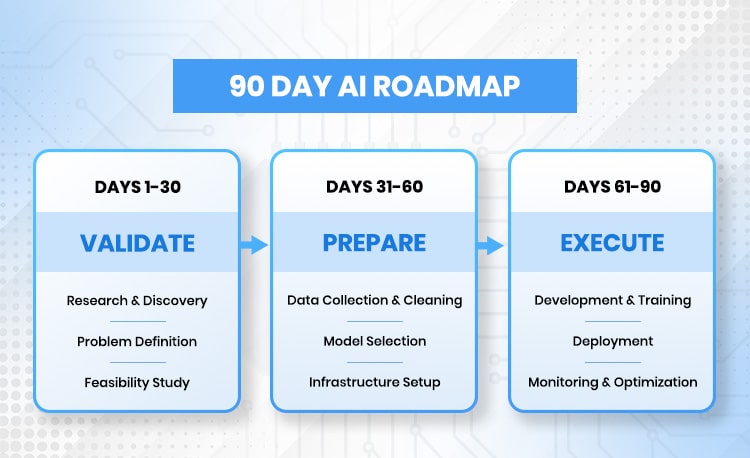
A structured 90-day roadmap provides a practical bridge between experimentation and enterprise adoption. It introduces focus, accountability, and momentum while ensuring that technical progress remains aligned with business objectives. For program managers, this roadmap is not about model internals or algorithms. It is about orchestration, risk management, and execution across teams.
Why a 90-Day Roadmap Matters
AI projects often struggle when teams attempt to move directly from experimentation to full-scale deployment. While early results may look promising, the absence of structure causes critical issues to surface too late in the process. Questions around ownership, governance, cost management, security, and operational readiness are frequently overlooked during experimentation and only become visible when deployment is already underway. At that point, resolving these issues is more expensive, time-consuming, and disruptive.
A time-bound roadmap facilitates controlled and intentional progression from idea to execution. It allows teams to balance speed with stability by introducing checkpoints where assumptions can be tested and risks can be addressed early. Rather than rushing forward or stalling indefinitely, organizations can move with purpose while maintaining control over scope and complexity.
A 90-day roadmap also establishes a shared understanding across technical and non-technical stakeholders. By dividing the journey into clear phases, program managers can communicate expectations more effectively and align diverse teams around common objectives. Progress becomes easier to track, decisions become more transparent, and tradeoffs can be discussed openly.
This shared clarity is essential for building trust with leadership. Executives gain confidence when they can see how AI initiatives are governed, measured, and managed over time. As a result, a structured roadmap not only improves execution but also strengthens long-term executive support.
The First 30 Days: Focusing on Validation
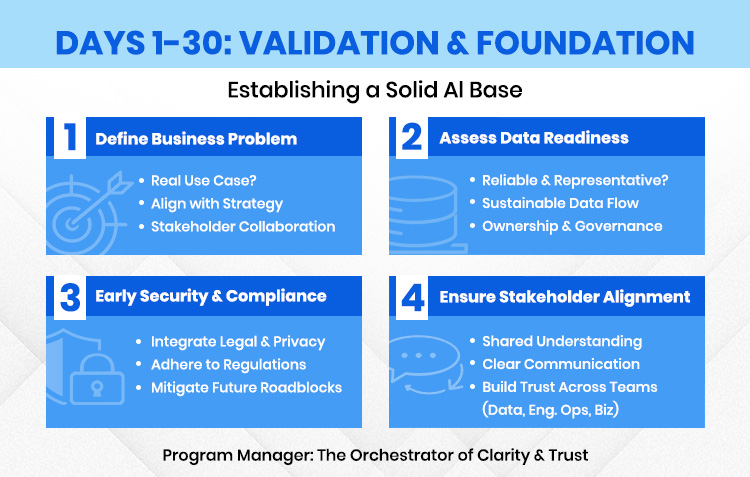
The initial phase of the roadmap should focus squarely on validation. During the first 30 days, program managers must determine whether the PoC is solving a real and measurable business problem rather than demonstrating technology for its own sake. This requires close collaboration with business stakeholders to clearly define the problem, identify who is affected, and articulate the outcomes the organization expects to achieve. Without this clarity, even technically impressive AI solutions struggle to gain long-term support.
AI initiatives that lack a strong business anchor often fail to progress beyond experimentation. Program managers play a critical role in challenging assumptions early and ensuring that the proposed use case aligns with strategic priorities. This may involve asking difficult questions about value, feasibility, and relevance. A clearly written outcome statement helps set direction, prevents scope creep, and provides a benchmark against which progress can be evaluated throughout the project lifecycle.
Data readiness is another essential focus during this phase. Many PoCs rely on limited, curated, or one-time datasets that do not reflect real-world operating conditions. Program managers should assess whether the data is reliable, representative, and available on an ongoing basis. Key questions include who owns the data, how it is accessed, how quality is maintained, and whether governance controls are in place. Addressing these issues early reduces the risk of delays and rework later.
Security, privacy, and compliance considerations must also be introduced during the validation phase. While these topics are sometimes postponed until deployment, doing so often creates obstacles that could have been avoided. Early engagement with security, legal, and compliance teams helps ensure the AI initiative aligns with organizational policies and regulatory expectations from the beginning.
Finally, stakeholder alignment is critical. Program managers should establish a shared understanding across data science, engineering, operations, and business teams. Clear communication around scope, limitations, risks, and timelines builds trust and creates a strong foundation for the phases that follow.
Days 31–60: Preparing for Production
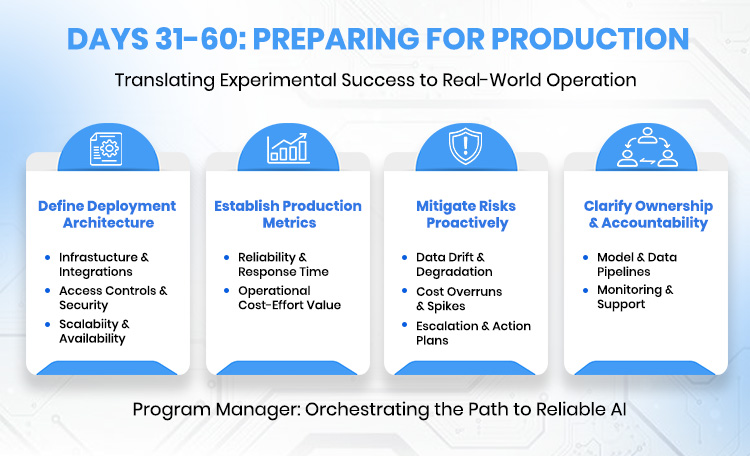
Once the foundation has been validated, the roadmap shifts toward operational readiness. The next 30 days focus on translating experimental success into production-capable planning. At this stage, the question is no longer whether the AI solution works in principle, but whether it can operate reliably, securely, and efficiently within the organization’s existing environment.
Deployment architecture becomes a central consideration during this phase. Program managers work closely with engineering and infrastructure teams to determine where the model will run, how it will be accessed, and how it will integrate with existing systems and workflows. Decisions related to infrastructure, access controls, scalability, and availability must be made with long-term operations in mind. These choices should balance performance expectations with cost constraints and security requirements.
Defining success through production metrics is another critical activity. While model accuracy may have been sufficient during the PoC stage, production environments require a broader set of performance indicators. These often include system reliability, response times, operational costs, and user adoption levels. Clear and measurable metrics allow teams to monitor performance objectively and provide early warning signs when adjustments are needed.
Risk identification and mitigation take center stage during this phase. Common risks include data drift, gradual performance degradation, rising infrastructure costs, and gaps in operational ownership. Program managers play a key role in ensuring that these risks are clearly documented and actively monitored. Each identified risk should be linked to specific mitigation actions and escalation paths to avoid surprises after deployment.
Ownership must also be clarified before moving into production. Many AI initiatives struggle because responsibility shifts or becomes unclear once the system goes live. Program managers should ensure that roles are well-defined across model ownership, data pipelines, monitoring processes, and change management. Clear accountability ensures issues are resolved quickly and prevents erosion of confidence among stakeholders as the initiative moves forward.
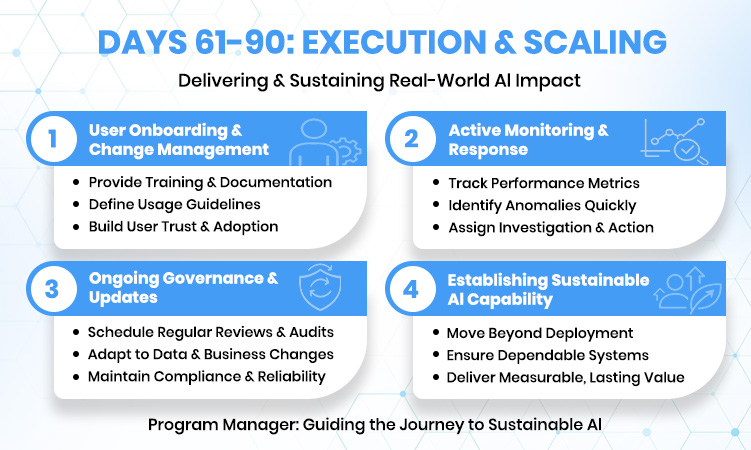
Days 61–90: Focusing on Execution and Scaling
The final phase of the roadmap is focused on execution and scaling. During the last 30 days, planning transitions into delivery as the AI solution moves into live production. Program managers coordinate deployment activities to ensure that technical components, governance controls, and business processes are fully prepared. This phase requires careful orchestration to avoid disruptions while moving the solution into active use.
User onboarding and change management are critical at this stage. Even a well-designed AI system can fail to deliver value if users do not understand how to interact with it or lack confidence in its outputs. Program managers should work closely with business teams to provide practical training, clear documentation, and well-defined usage guidelines. These efforts help users integrate the AI solution into their daily workflows and build trust over time.
Monitoring must be active from the first day of production. This includes tracking key performance metrics, identifying anomalies, and responding quickly to unexpected behavior. Program managers should ensure that monitoring processes are clearly defined and that responsibility is assigned for investigation, escalation, and corrective action. Effective monitoring helps detect issues early and prevents minor problems from becoming major disruptions.
Governance does not end once the system is deployed. The final phase should include plans for ongoing reviews, audits, and updates to ensure continued alignment with organizational standards. AI systems evolve as data changes and business needs shift, which makes periodic reassessment essential. Program managers must ensure that mechanisms are in place to adapt responsibly while maintaining compliance, reliability, and transparency. By managing execution and scaling thoughtfully, organizations can move beyond deployment and establish AI as a dependable and sustainable capability.
Why Program Managers Are Central to AI Scaling
Scaling AI successfully is not purely a technical challenge. While models, data, and infrastructure are important, they represent only part of the equation. The larger challenge lies in coordinating people, processes, and priorities across the organization. This is where program managers play a central role. They act as the connective tissue that aligns technical execution with business intent and organizational constraints.
Program managers translate technical progress into language that business leaders understand. They help stakeholders see how AI initiatives support strategic goals, manage tradeoffs, and deliver measurable outcomes. By framing progress in terms of value, risk, and readiness, program managers ensure that AI initiatives remain relevant and supported beyond the experimentation phase.
Risk management is another critical responsibility. AI systems introduce new types of risk, including data quality issues, model drift, bias, operational instability, and regulatory exposure. Program managers are responsible for identifying these risks early, coordinating mitigation efforts, and ensuring that governance controls are integrated into delivery rather than added as an afterthought. This proactive approach can reduce late-stage issues and reinforce leadership confidence.
Accountability is equally important. Without clear ownership, AI initiatives often struggle after deployment. Program managers ensure that responsibilities are defined across model ownership, data pipelines, monitoring teams, and change management. This clarity helps teams respond quickly to issues and prevents problems from being ignored or deferred.
A disciplined 90-day roadmap gives program managers a practical framework for guiding AI initiatives from experimentation to impact. It provides structure without rigidity, allowing teams to move forward while maintaining control. By using this framework, program managers help organizations avoid common pitfalls, maintain stakeholder confidence, and deliver AI systems that create measurable and sustainable value over time.
Closing Perspective
Moving from PoC to production is not about making the AI smarter. It is about making the program stronger. With a clear roadmap, defined ownership, and integrated governance, organizations can transform promising experiments into dependable systems that deliver real business impact.
About the Author

Imran Afzal
CEO of UTCLI Solutions
Imran Afzal, CEO of UTCLI Solutions and a best-selling IT instructor, has trained over a million students worldwide in IT, systems administration, and career development. An educator, mentor, and entrepreneur, he brings over 25 years of experience in systems engineering, leadership, and training across Fortune 500 companies in finance, fashion, and tech media.
His IT journey began in 2001 at Time Warner, NYC, and has since included leading major projects like data center migrations, VMware deployments, monitoring tool implementations, and Amazon cloud migrations. Imran holds a degree in Computer Information Systems from Baruch College (CUNY) and an MBA from NYIT.
Certified in Linux System Administration, VMware, UNIX, and Windows Server, Imran has been training students since 2010 through top-rated online courses and on-site programs. His mentorship has helped thousands secure IT jobs.
Beyond IT, Imran is dedicated to education and community service, founding a nonprofit school for children (pre-K to 10th grade).