What motivated you to pursue the CEH certification?
In the industry I work in, there is no standard certification framework like those found in networking, firewalls, or cloud security. Certification authorities in my sector offer limited options, so I wanted a credential that would demonstrate my expertise and validate my knowledge in this domain.
How did the CEH certification contribute to your career goals and other important aspects?
Since there are very few certifications relevant to my specific IT field, CEH was extremely helpful. As I was entering the cybersecurity space, it provided me with the foundational knowledge and insights necessary to navigate and understand the field I am now working in.
Did CEH help you get higher salary, a promotion, or the job you wanted?

Yes, definitely. It helped me secure a higher salary because the certification enabled me to contribute beyond my original sales role.
I was able to take on additional responsibilities and demonstrate broader expertise.
What aspects of the CEH program are most interesting or valuable to you, and how have they contributed to your professional development?
The most interesting part of the CEH program is the hands-on labs. They go beyond theoretical learning by allowing you to practice real-world techniques. This has been especially useful during my presentations, where I can demonstrate concepts through live demos.
How widely recognized and respected is the CEH certification in the cybersecurity industry? How does your organization view it?
Whenever I mention my CEH certification during talks or presentations, it always generates a strong positive reaction. Many people ask about my experience taking the exam, which demonstrates its widespread recognition in the industry.
My organization also places a high value on certification. During customer meetings, they appreciate seeing CEH listed among my credentials, especially since I pursued and passed it independently.
Have you taken any other cybersecurity courses? How does CEH differ from other certifications in terms of skills, knowledge, and career value?
Yes, I have taken other cybersecurity courses, but most were purely theoretical with no hands-on labs. Compared to those, CEH stands out because of its practical, lab-based approach, which deepened my understanding of cybersecurity concepts and techniques.
Have you completed the Security+ course? How does CEH differ from Security+ and other certifications?
I consulted a trainer who offered both Security+ and CEH and asked which one I should take as a beginner in cybersecurity. He recommended CEH, and I agree that it provides a stronger practical foundation compared to the more theoretical Security+.
How critical or helpful is the CEH training for career development in cybersecurity or IT?
CEH is extremely valuable, especially for beginners. It helps you build a strong foundation in cybersecurity concepts and techniques. The certification provides the footing needed to grow confidently in the cybersecurity field.
Should IT professionals pursue the CEH certification? Why is it relevant in today’s digital landscape?
It depends on the individual, but I personally believe yes.
Continuous learning is essential today, and CEH provides a significant advantage.
In a rapidly evolving landscape, staying updated is critical, and CEH supports that growth.
Tell us about your journey as a cybersecurity professional.
Before entering cybersecurity, I worked in the telephony industry, specifically in VoIP. As I began exploring cybersecurity, I sought certifications that would enhance my knowledge and career prospects. CEH stood out as the most beneficial starting point for my professional journey.
How has the integration of AI tools enhanced your ethical hacking skills and efficiency?
AI has completely transformed the landscape. Previously, ethical hacking relied heavily on manual human effort. Now, with AI, especially in a post-quantum world, the complexity has increased, and we must continuously upgrade our skills. AI enhances efficiency but also introduces new challenges that require ongoing learning.
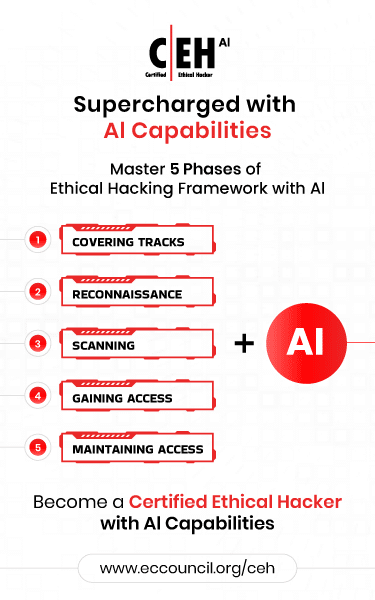
Can you share an experience where AI played a crucial role in one of the five phases of ethical hacking?
AI has made reconnaissance significantly easier. In the past, you had to manually monitor outputs and scan systems. Today, AI can automate reconnaissance, scanning, gaining access, and even aspects of maintaining access, significantly improving efficiency and effectiveness in ethical hacking tasks.
Conclusion
The CEH certification proves highly valuable for both beginners and experienced IT professionals, offering hands-on skills, credibility, and industry relevance. Its practical approach, strong recognition, and alignment with modern cybersecurity challenges—especially with AI integration—make it a powerful stepping stone for career advancement and long-term success in the cybersecurity field.
About the Interviewee

Neil Jason Salcedo
Neil Jason is a Certified Ethical Hacker and (ISC)² Certified Cybersecurity professional with over 20 years of experience in IT infrastructure, enterprise security, and unified communications. He specializes in PKI, TLS/SSL, API integrations, and solution architecture, driving secure deployments and client success across APAC, Australia, and New Zealand.