Career transitions in cybersecurity require relevant skills, technical depth, and hands-on experience. To understand the role of the Certified Ethical Hacker (CEH) in enabling professionals to transition into advanced cybersecurity roles, EC-Council interviewed ethical hacker and penetration tester Omar Tamer. This interview explores Omar’s journey with CEH, advanced ethical hacking, AI-enhanced techniques, and real-world experience. It highlights the value of hands-on learning, global recognition, AI-driven skill enhancement, and the CEH pathway’s impact on confidence, technical depth, career readiness, and practical offensive security capability across evolving threat landscapes.
What motivated you to pursue the Certified Ethical Hacker (CEH) certification?
Curiosity and a love for solving problems through technology motivated me to pursue CEH. From a young age, I was fascinated by how systems communicate and how attackers exploit them. CEH stood out because it covers every corner of cybersecurity in one program, which is rare for an entry-level certification. It includes web application testing, network attacks, IoT hacking methodologies, cloud computing, cryptography, and even social engineering.
This breadth helped me test myself across different domains and discover what I enjoyed most, whether web exploitation, network attacks, or mobile security. CEH provided the foundation that helped me move confidently into more advanced areas.

CEH provided the foundation that helped me move confidently into more advanced areas.
How did the CEH certification contribute to your career goals and other important aspects?
CEH gave me structured exposure to the entire attack lifecycle. It taught me how to execute and defend against real-world threats. For example:
- Reconnaissance: Google dorking, Nmap scanning, and banner grabbing
- Scanning: TCP/UDP scans and version detection
- Exploitation: Metasploit, privilege escalation, XSS, SQL injection
The hands-on labs made the most significant impact. I gained practical fluency with tools like John the Ripper and Wireshark. The certification program strengthened both my technical skills and credibility during interviews and reporting.
Did CEH help you get higher pay, a promotion, or a job?
Yes, CEH definitely helped me early in my career. It gave me a level of recognition that fresh graduates rarely receive. Having “Certified Ethical Hacker” on my profile showed recruiters that I was serious about cybersecurity, even before I had gained years of experience. It directly helped me secure remote jobs early on, as recruiters trusted the credibility CEH provides.
What aspects of the CEH program were most valuable to you?
The balance between theory and hands-on practice was the most valuable part of the program. CEH built a strong foundation in protocols, encryption, attack surfaces, and frameworks, while the labs and practical exam pushed me to simulate real attacks under pressure. The breadth of coverage was unique and beyond web and network security. CEH included critical infrastructure, IoT, and OT security, which I had never seen in another entry-level certification. This broadened my perspective and pushed me to explore new domains.
How widely recognized and respected is CEH, and how does your organization view it?
CEH is one of the most globally recognized cybersecurity certifications.
Unlike certifications that are strong only in certain regions, CEH is respected worldwide, making it extremely valuable for international opportunities.
In job descriptions, LinkedIn profiles, and industry requirements, CEH consistently appears as a baseline standard for ethical hacking roles. Recruiters even use it as a keyword filter. Organizations value CEH because it demonstrates that a professional can think like an attacker, simulate real-world threats, and work within legal and ethical frameworks. This combination builds trust and ensures readiness for offensive security roles.
Have you completed any other cybersecurity courses? If so, how does the CEH differ in terms of skills, knowledge, career advancement, and overall value?
Yes, I’ve taken other cybersecurity courses, but the Certified Ethical Hacker (CEH) stands on a completely different level in terms of depth and technical coverage. Instead of just reading about scanning or enumeration, CEH required me to actually perform the scans, identify live targets, exploit them, and produce recommendations. During the CEH practical exam, everything I had studied including privilege escalation, potential attacks, and Active Directory exploitation became a real-world challenge under strict time pressure. One of CEH’s most significant advantages is that it allows you to transfer credit hours toward a degree at EC-Council University, something no other certification program offers.
Passing both the CEH exam and CEH (Practical) awards you the title of CEH (Master), meaning you gain knowledge and hands-on skills, and get validation of both with the CEH (Master). This makes CEH more than a certification; it becomes a pathway for academic progress and long-term career credibility. Personally, I view this as a significant opportunity, as I plan to enroll at EC-Council University, and CEH provides a direct academic pathway to begin that journey.
How critical or helpful is CEH training for career development in cybersecurity or IT?
CEH training is crucial for anyone seeking to advance in cybersecurity. What makes it stand out is the perfect balance of theory and practical experience. You don’t just learn concepts, you see attacks unfold in real time and learn how to defend against them, which builds technical fluency and confidence. Another major strength is CEH’s wide coverage, as it introduces you to networks, web applications, IoT & OT security, cloud, cryptography, and critical infrastructure. This broad exposure enables learners to explore the entire field before selecting a specialization.
From a career perspective, CEH is globally recognized and often viewed as the first serious step into cybersecurity. Many IT professionals use it as their bridge into the security domain because employers understand the value it brings. For me, the CEH certification was the one that turned my passion into a career.
Should IT professionals pursue CEH? Is it essential in today’s landscape?
Absolutely, every IT professional is directly or indirectly connected to cybersecurity. Whether you manage databases, networks, cloud environments, or infrastructure, attackers can exploit vulnerabilities in all of these areas. CEH gives IT professionals the attacker’s mindset, which is extremely powerful.
You don’t just learn how to configure systems, but also understand how someone could break them. CEH helps IT professionals in two significant ways:
- Technical Insight: You understand the fundamentals of attacks across networks, applications, IoT, OT, and cloud.
- Career Mobility: CEH is the perfect bridge for IT professionals transitioning into cybersecurity roles.
In today’s era of digital transformation, where every business is a target, CEH is no longer optional for IT teams; it is essential. Adding CEH to your profile signals to recruiters that you’ve moved from just managing IT to actively defending it.
Adding CEH to your profile signals to recruiters that you’ve moved from just managing IT to actively defending it.
Tell us about your journey as a cybersecurity professional.
I’ve always been curious about how technology works and how attackers think. One early question that stuck with me was: “If someone controls the Wi-Fi, can they control my phone?”
I didn’t know the answer then, but when I studied MITM attacks in CEH, everything fell into place. That moment sparked my journey. What makes my path unique is that I started with CEH even before having a traditional IT background. While still in school, I pushed myself through the material, and by my second year of university, I had already earned my CEH certification. That became the foundation for everything that followed. Now at 21 and a fresh graduate, I can see how far CEH has taken me. From there, I advanced to earning CEH Master, CPENT, and LPT Master, along with eJPT from INE security and PCEP from the Python Institute.
I also became a top-ranked competitor across various well-known CTF platforms, competing at the highest level against cybersecurity professionals worldwide. Currently, I am gaining hands-on industry experience as an Information Security Intern at Fawry, one of the leading digital payments companies in the Middle East and Africa. This role lets me apply my skills in a real-world, high-impact environment. Looking back, CEH wasn’t just my first certification, it was the launchpad that transformed my curiosity into a professional career in offensive security.
How has the integration of AI tools, skills, and techniques enhanced your ethical hacking skills and efficiency in real-world scenarios?
Initially, I often lost hours fixing minor script errors or rerunning scans due to a single typo. Once I integrated AI into my workflow, it felt like having a teammate by my side. AI helped debug my code, provided correct syntax, and automated repetitive parts of engagements.
One turning point has been scan analysis. I used to spend a long time digging through raw data, but when I let AI take over, it immediately highlights the relevant CVEs, suggests exploitation paths, and saves me several hours.
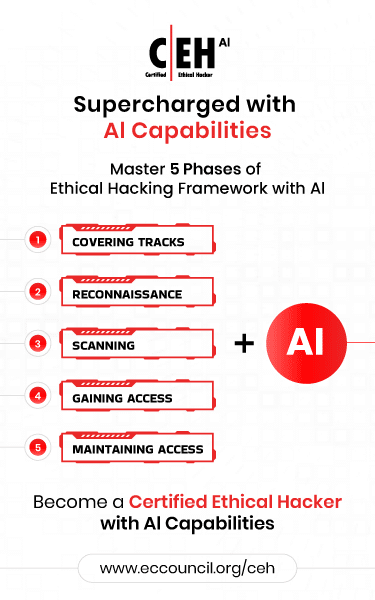
What excites me even more is that CEH v13 not only teaches hacking techniques but also how to utilize AI throughout reconnaissance, exploitation, and defensive workflows.
For me, it has become a second brain in the terminal, handling repetitive work while I focus on strategy and creativity.
Can you share an experience where AI played a crucial role in one of the five phases of ethical hacking?
Yes. During one assessment, I encountered an unusual port that I had never seen before. Normally, I would spend hours researching it. Instead, I turned to AI and within seconds, it provided a complete breakdown of the port’s purpose, standard services, typical vulnerabilities, and possible exploits.
I went from “What is this?” to “Here’s how I can attack it” in minutes. AI then helped clean up noisy scan results, map service versions to match CVEs, and recommend exploitation paths. It felt like having a senior penetration tester sitting beside me, guiding each step. That experience alone proved how dramatically AI can optimize the entire attack lifecycle.
What specific benefits have you seen from integrating AI-based skills learned in CEH into real-world ethical hacking tasks?
One of the most impressive AI tools I’ve used is ShellGPT. Unlike regular GPT tools, where you copy commands back and forth, ShellGPT runs directly into the terminal. You simply describe what you want. For example, scanning a subnet or running Nmap with specific flags and it executes the command instantly. This saves enormous time during assessments.
Beyond speed, ShellGPT fixes script errors on the fly, suggests more efficient commands, and even maps vulnerabilities to the correct CVEs. A memorable example occurred during a pentest, where my privilege escalation script repeatedly failed. ShellGPT immediately identified the issue and corrected it, saving me at least thirty minutes of manual debugging.
That’s when I realized its real value: ShellGPT isn’t just a helper, it’s an integrated assistant. It doesn’t replace the hacker’s mindset, but it significantly enhances my speed, accuracy, and efficiency during real-world ethical hacking tasks.
Conclusion
AI has transforms the ethical hacking workflow by reducing manual effort, accelerating reconnaissance, improving exploitation accuracy, and streamlining automation. CEH’s AI-driven training empowers professionals to work smarter and handle complex real-world tasks with greater confidence and speed.
CEH, combined with AI-enabled tools and practical training, has a significant impact on technical expertise, decision-making, and career trajectory. From foundational concepts to advanced offensive security skills, the program provides credibility, versatility, and real-world readiness.
About the Interviewee

Omar Tamer
Omar Tamer is a cybersecurity professional specializing in offensive security and penetration testing. He holds CEH Master, CPENT, and LPT Master certifications from EC-Council. With hands-on experience in penetration testing, Active Directory exploitation, IoT/OT security, and professional reporting, he focuses on applying real-world offensive techniques to strengthen organizational security. Currently, he is gaining hands-on industry experience at Fawry, one of the leading digital payments companies in the Middle East and Africa. This role allows him to apply his skills in a real-world, high-impact environment.