Strengthening Cybersecurity Skills with CEH: Interview with Cesar Vega
What motivated you to pursue the CEH certification?
As a cybersecurity leader, I pursued the CEH certification to strengthen my technical foundation. Having technical knowledge is essential for making informed decisions at a managerial level, and CEH helped me complete my professional profile with hands-on ethical hacking expertise.
How did the CEH certification contribute to your career goals and other important aspects?
The certification enhanced my profile by providing practical knowledge in penetration testing. It increased recruiter confidence and helped me stand out from other candidates. Most importantly,

CEH strengthened my self-confidence when interacting with technical stakeholders.
Did CEH help you get higher pay, a promotion, or desired job?
While CEH did not directly result in a promotion or salary increase, it significantly boosted my confidence in understanding technical issues. This helped me make better management-level decisions related to vulnerability management, risk management, and compliance.
What aspects of the CEH program were most valuable to you and how did they support your professional development?
CEH helped me understand penetration testing and supported my ability to develop effective cybersecurity programs. Learning the hacker mindset enabled me to make better decisions about controls and strategies that strengthen my organization’s security posture.
How widely recognized and respected is CEH in the cybersecurity industry? How does your organization view it?
As a hiring manager, I believe CEH is a strong differentiator. It signals reliability and confirms that the candidate understands penetration testing and the hacker mindset.
Organizations view CEH holders as technically capable and trustworthy cybersecurity professionals.
Have you completed other cybersecurity courses? How does CEH differ in skills, knowledge, and value?
Yes, I have completed certifications in cybersecurity management, information security management, risk management, penetration testing, incident response, and digital forensics. CEH stands out because it teaches how hackers think, enabling you to proactively identify and address vulnerabilities. It provides real, practical hacking skills.
How does CEH differ from Security+ and similar certifications?
I hold both Security+ and CEH. Security+ is excellent for understanding core cybersecurity concepts, but CEH is more practical and focused on penetration testing. This hands-on approach makes CEH especially valuable for technical cybersecurity roles.
How critical is CEH for career development in cybersecurity or IT?
CEH is an important milestone for cybersecurity professionals. It is highly recognized across the industry and often expected at higher professional levels.
CEH certification serves as a strong stepping stone for long-term career growth in cybersecurity.
Should IT professionals pursue the CEH certification? Why?
Absolutely. Information is one of the most valuable assets for companies today. IT professionals must understand threats and vulnerabilities within their systems.
CEH provides essential knowledge that is becoming almost mandatory in modern cybersecurity environments.
How has AI enhanced your ethical hacking skills and efficiency?
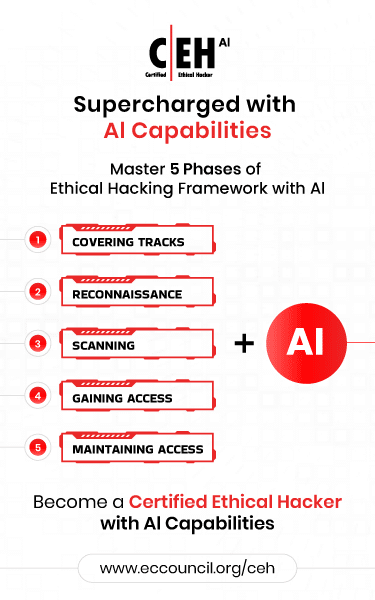
AI significantly improves vulnerability assessments, penetration testing, and malware analysis. As cybersecurity professionals, we must understand AI trends and apply human judgment to interpret AI-generated insights effectively.
Can you share an example where AI played a crucial role in one of the five phases of ethical hacking?
AI is especially valuable in malware analysis. It helps identify known and potential malware signatures and detect unusual behaviors quickly, making threat identification more efficient and accurate.
What specific benefits have you seen from integrating AI-based skills learned in CEH into real-world ethical hacking tasks?
AI greatly increases the speed, efficiency, and reliability of processes such as malware scanning and detecting malicious activities. However, human judgment remains essential to distinguish between useful insights and irrelevant or incorrect outputs.
Conclusion
The CEH certification stands out as a practical, industry-respected credential that sharpens technical skills and deepens understanding of the hacker mindset. Combined with emerging AI-driven tools, it equips professionals to manage threats more effectively. Overall, CEH remains a powerful career asset for advancing in cybersecurity and IT leadership.
About the Interviewee