The Evolution of Cybersecurity Leaders: Interview with Michael Shost
What motivated you to pursue the CEH certification?
As cybersecurity threats continue to evolve, I pursued the CEH certification to strengthen my ability to think like a malicious attacker while staying grounded in the ethical framework needed to protect systems and data. CEH not only validated my technical expertise but also provided structured methodologies for identifying vulnerabilities. Its dual approach, teaching both attacker mindset and ethical practices, is what truly motivated me to pursue it.
How did the CEH certification contribute to your career goals and other important aspects?

The CEH certification aligned directly with my goal of becoming a trusted authority in cybersecurity.
Did CEH help you get higher pay, promotion, or a desired job?
Absolutely.
CEH significantly enhanced my credibility in the industry and positioned me for better opportunities.
Its strong recognition among hiring managers and leadership teams contributed to my eligibility for a promotion and played a key role in securing a higher-paying role within my organization.
What aspects of the CEH program are most valuable, and how have they contributed to your professional development?
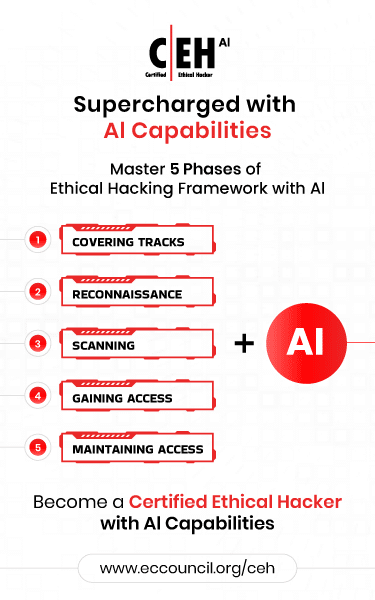
The hands-on, lab-based structure of the CEH program is its most valuable aspect. Real-world attack simulations helped me gain practical experience with industry-standard tools and techniques. The structured five-phase ethical hacking process—reconnaissance, scanning, gaining access, maintaining access, and covering tracks—strengthened my ability to work systematically, which I now apply daily in my role.
How widely recognized is the CEH certification in the cybersecurity industry, and how does your organization view it?
CEH is widely recognized as a gold-standard cybersecurity certification.
Have you completed other cybersecurity courses? If so, how does CEH differ in skills, knowledge, career advancement, and overall value?
I’ve completed the CCISO course and related training, and while those certifications are excellent, CEH stands out for its strong focus on offensive security. It equips professionals to proactively identify and exploit vulnerabilities before attackers do. This offensive, hands-on approach gives CEH a distinct advantage for skill development and career growth. While other courses provide value, CEH serves as both a strong starting point and a versatile foundation upon which to build specialized certifications and advanced training.
Have you completed the Security+ course? If so, how does CEH differ from Security+ and similar certifications?
Yes, I’ve completed Security+, which offers an excellent foundational understanding of key security concepts. However, CEH goes much deeper into the offensive side of cybersecurity, emphasizing penetration testing and real-world hacking techniques. Security+ is ideal for building your base knowledge, but CEH prepares you to actively test and defend systems, providing more advanced skills and broader career advancement potential.
How critical or helpful is CEH training for career development in cybersecurity or the IT industry?
CEH training is essential for anyone serious about progressing in cybersecurity. It teaches professionals to anticipate and counteract malicious tactics, a crucial skill in today’s threat landscape.
This significantly boosts employability and career opportunities across both cybersecurity and IT. In my case, combining CEH with my PMO experience positions me strongly for roles in security operations centers, cybersecurity-focused PMOs, and the delivery of complex, high-value cybersecurity initiatives for Fortune 100 clients.
Should IT professionals pursue the CEH certification? If so, why?
Absolutely. CEH provides IT professionals with valuable insight into how systems are attacked, helping them design stronger architectures and collaborate more effectively with cybersecurity teams. In today’s digital-first world, this knowledge is indispensable. CEH has strengthened my effectiveness, increased my cybersecurity awareness, and helped spread that awareness across my team and organization. As technology evolves, everyone will need to understand basic cybersecurity principles, and CEH delivers that exceptionally well.
Tell us about your journey as a cybersecurity professional.
My cybersecurity journey has been driven by a passion for protecting critical systems and data. I began my career as a software engineer and later transitioned into PMO and enterprise delivery, where cybersecurity increasingly became a major component of my work. As I moved into leadership roles managing high-profile, mission-critical initiatives, it became clear that I needed deeper cybersecurity expertise. This realization launched my formal journey into the field.
The CEH certification was a major turning point, equipping me with advanced tools, methodologies, and an attacker’s mindset. It eventually led me to pursue the CCISO certification. Today, I lead initiatives that integrate offensive and defensive security practices to ensure strong protection for private and government organizations. These certifications have given me the credibility to take on more complex roles and to combine cybersecurity with emerging technologies in innovative ways. I feel I’m still in the middle of my journey and with AI, ML, and DL becoming central to cybersecurity, the future is incredibly exciting.
How has the integration of AI tools and techniques enhanced your ethical hacking skills and efficiency?
AI has transformed ethical hacking by enabling automated reconnaissance, advanced pattern recognition, and predictive threat modeling.
Integrating AI allows me to identify vulnerabilities faster, analyze massive data sets, and simulate complex attack scenarios with greater accuracy. AI and ML let me accomplish more in less time, significantly improving efficiency and precision. We are still in the early stages of what AI can achieve, making this an exciting era for cybersecurity professionals looking to apply these technologies in innovative ways.
Can you share an experience where AI played a crucial role in one of the five phases of ethical hacking?
During a penetration testing engagement—a discipline I became deeply passionate about—I used AI-driven reconnaissance tools to analyze large volumes of publicly available data. These tools helped me quickly identify critical misconfigurations and potential entry points that would have taken far longer to uncover manually. This efficiency allowed me to shift my focus to designing strong mitigation strategies rather than spending excessive time on data collection. AI and ML have already proven game-changing, and we’re only at the beginning of their integration into ethical hacking.
Conclusion
The CEH and CCISO certifications significantly strengthened cybersecurity expertise, credibility, and career growth. When paired with AI-driven techniques, the skills gained from these certifications enable more accurate, efficient, and proactive security practices. This progression reflects how professionals can use emerging technologies to stay ahead of evolving threats in today’s dynamic digital landscape.About the Interviewee

Michael Shost
Michael Shost is a cybersecurity and PMO leader with over 25 years of experience driving global programs, data governance, and AI-powered transformations. A certified C|CISO, CEH, and PMP, he specializes in risk management and enterprise resilience, advising Fortune 500 firms and boards on strategic cybersecurity and digital growth initiatives.