
Risk and Vulnerability Management: Steps to Improve Security with AI-Driven Enhancements
- Gabriel Mandefu
- Ethical Hacking
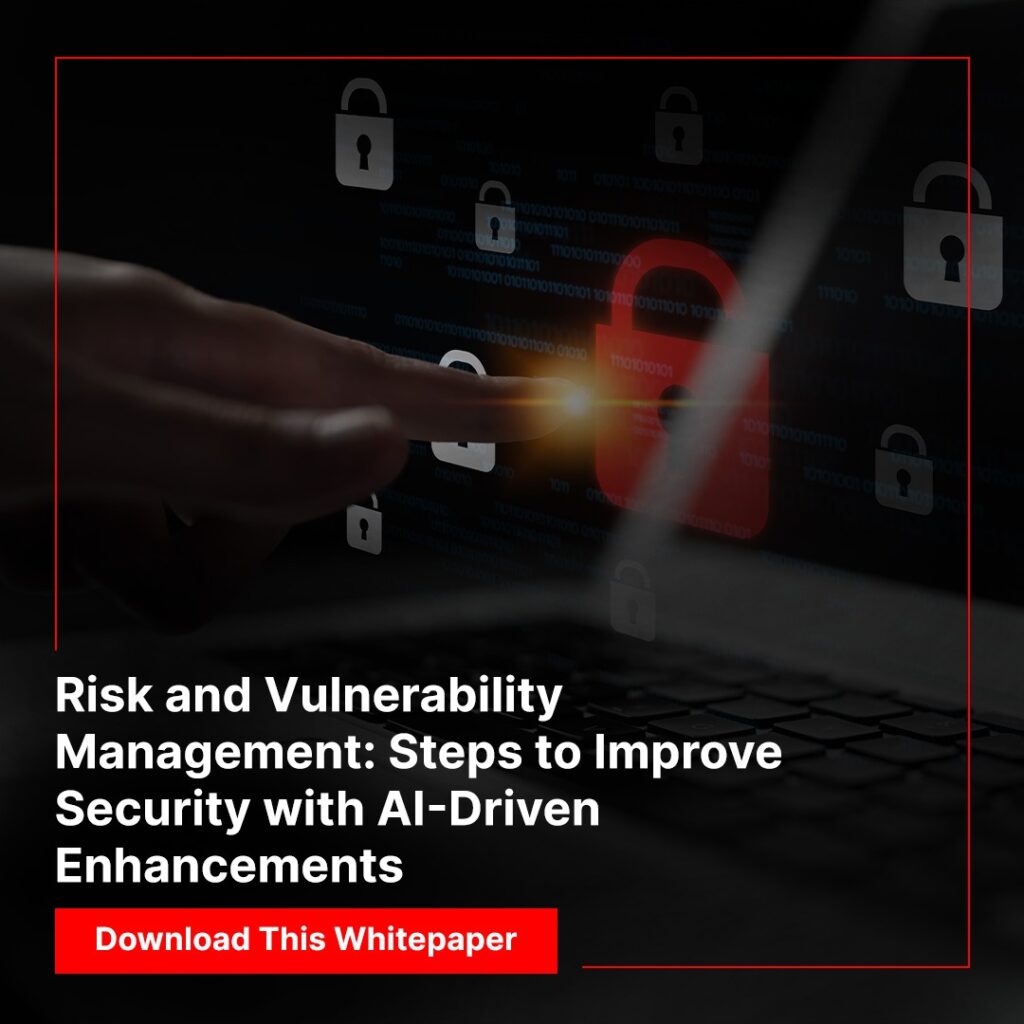
The modern enterprise operates across hybrid IT, multi-cloud, SaaS, and identity-centric environments where vulnerabilities can translate into immediate operational, financial, and reputational impact. As threat actors leverage automation, ransomware-as-a-service, and identity abuse, traditional, periodic security assessments are no longer sufficient. This whitepaper, Risk and Vulnerability Management: Steps to Improve Security with AI-Driven Enhancements, presents a comprehensive, lifecycle-based approach to managing risk in dynamic digital ecosystems, reinforced by artificial intelligence (AI) capabilities.
Grounded in globally recognized frameworks such as ISO/IEC 27001, NIST Cybersecurity Framework, and MITRE ATT&CK, the paper distinguishes between information security and IT security, emphasizing that effective protection extends beyond technical controls to governance, people, and process domains. It outlines a structured vulnerability management lifecycle—baseline creation, vulnerability assessment, risk assessment, remediation, verification, and continuous monitoring—ensuring that security programs remain aligned with business priorities and evolving threat conditions.
A key theme of the whitepaper is AI augmentation across every phase of the lifecycle. During baseline creation, AI accelerates asset discovery and identifies shadow IT. In assessment and risk analysis, machine learning models prioritize vulnerabilities based on exploit likelihood, asset criticality, and real-world threat intelligence. AI-driven remediation recommendations reduce operational disruption, while continuous monitoring leverages behavioral analytics and automated triage to minimize alert fatigue and improve response times. These capabilities enhance decision-making without replacing human judgment, embedding intelligence directly into governance and operational workflows.
The paper also addresses emerging risks associated with generative AI and large language models, providing practical safeguards to manage prompt injection, excessive agent permissions, and data leakage. By integrating AI governance with exposure management, identity security, and secure-by-design principles, organizations can strengthen resilience while maintaining accountability and transparency.
Ultimately, this whitepaper serves as a strategic and operational guide for security leaders seeking to modernize risk and vulnerability management. By combining disciplined governance with AI-enabled technical rigor, enterprises can reduce exposure, accelerate remediation, and sustain a proactive, business-aligned security posture in an increasingly complex threat landscape.