- Last Updated : July 24, 2026
- Executive Management
Introduction to Risk Management
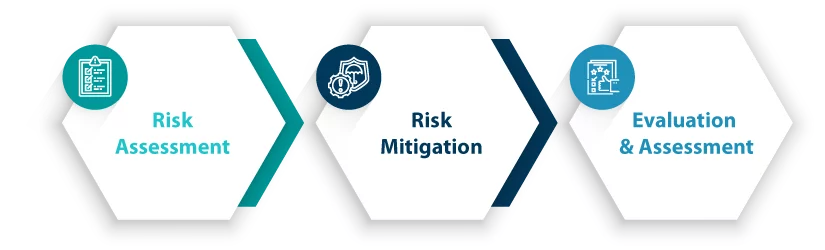
Layers of Enterprise Risk Management
A company faces many risks and needs specific approaches and department participation to handle the risks at various levels. Risks in a company can be classified into the following layers:
Business Risk Management
This includes strategic, reputational, financial, compliance/legal, organizational, and IT risks. It involves an enterprise risk management approach for identifying and managing all forms of business risks.
Organizational Risk Management
Operational risks are part and parcel of organizational risks. They arise from risks related to the structures of processes and technology.
IT Risk Management
IT risks are a subset of enterprise risk management, focusing on threats related to information technology, systems, and digital infrastructure.
Cybersecurity Risk Management
This layer deals with the risks of cybersecurity threats. It focuses on technology, procedures, and activities designed to protect the enterprise network infrastructure, information systems, programs, and data from attacks, disruptions, or unauthorized access.
Importance of Managing Risks
An integral part of this process is cyber risk management, supported by effective security governance practices. The goal of this risk management process is to evaluate and mitigate the multitude of new threats that come with the world of fast-track digital transformation.
Numerous elements are identified, evaluated, and rated during risk evaluations to summarize risks from high to low severity. This approach is far more than a compliance solution; it protects the IT assets of the company efficiently and maintains stability and business continuity against multiple unfortunate incidents.
Developing and implementing a cyber risk strategy within your organization helps you minimize the risks unique to your business and reduce cyberthreats. Here are the reasons why such a plan is essential for your organization:
- To identify and manage blind spots.
- To plan risk assessments.
- To identify emerging threats and exercise preventive measures to mitigate damages.
- To identify, manage, and counter cyberthreats.
- To create and implement a robust incident response protocol.
- To streamline IT systems.
- To ensure data safety and regulatory compliance.
4 Steps of the Risk Management Process
Risk Identification
The first step of the process is identifying vulnerabilities, which primarily entails brainstorming, and forms the foundation of any effective risk assessment framework. An organization brings its workers together so that all the possible points of risk can be checked. The next move is to organize in order of priority all the known threats. Since all current threats cannot be mitigated, only risks that will greatly impact an organization are handled on priority.
Risk Assessment
This stage is central to any risk management framework because it helps organizations identify the source and potential impact of identified risks. An organization can figure out the source of the risks by posing the question: What caused such a risk and how could it affect the company?
Response Formulation
After identifying and assessing risks, the next step is to determine the most appropriate response. Organizations evaluate each risk based on its potential impact and likelihood before deciding whether to avoid, mitigate, transfer, or accept it. A well-defined response strategy helps minimize disruptions, allocate resources effectively, and support business continuity.
Preventive Measures Against Identified Risks
The last step of the process is using preventive measures against identified risks. Here, the concepts that are considered helpful in risk reduction are built into a variety of activities and then into contingency measures that can be applied in the future. The preparations will be put into motion if threats exist.
What Is the NIST Risk Management Framework?
Risk assessment is a way of securing corporate assets and processes through the application of safety controls that facilitate the early identification and resolution of threats. This is accomplished through the RMF, which helps organizations strengthen security governance through greater structure and oversight to the life cycle of system implementation by incorporating cybersecurity and risk control into the early stages of the process of system creation.
The RMF also supports non-governmental companies with IT risk control activities, while federal agencies are expected to implement the RMF when designing frameworks for government channels.
The 7 Steps of the NIST RMF
By enforcing stringent controls for information security, the RMF lets organizations standardize risk protection. In order to execute it correctly, the RMF has seven measures you need to follow (NIST, 2018). The overarching aim of the seven steps is to clear programs for an authorization to operate (ATO) approval, which is when programs go live in a government setting.
The seven steps to achieve ATO via RMF are (NIST, 2018):
1. Preparation
2. Categorization
3. Selection
4. Implementation
5. Assessment
6. Authorization
7. Monitoring
1. Preparation
1. Preparation
This step was added by NIST in Revision 2 of the RMF, realizing the necessity of training the company to get the maximum benefit from RMF. Its purpose is to carry out essential activities at different levels of the organization to help prepare all levels of the organization to manage its security and privacy risks using the RMF (NIST, 2018).
2. Categorization
2. Categorization
This phase relates to how the system in question collects, stores, and transmits information. It allows you to identify how the system communicates with other IT systems and networks, to consider what you need to take compliance steps, and to create an architectural system overview.
3. Selection
3. Selection
Setting a benchmark for protection measures, depending on what group the vulnerability falls under during phase one, is part of the Selection step. During this step, you can make choices on what baseline protection measures you want to enforce.
4. Implementation
4. Implementation
The fourth stage consists of the application of the security steps laid down in step two. At this point, if you need to review your implementation after the next step, you can ensure that your implementation process is well established.
5. Assessment
5. Assessment
It’s time to make sure everything is running as expected during the fifth stage. The Evaluation stage is where you review to see if the categories and baseline security controls defined in the first steps were properly enforced. If not, you’ll need to go back to the implementation process before you move on to the fifth stage.
6. Authorization
6. Authorization
Depending on how you perform during the appraisal process, you will progress to the sixth level. Once the categories and protection measures have been fully enforced, the authority to operate (ATO) the device will be given or rejected. If it is rejected, once it checks out, the approval will be delayed.
7. Monitoring
7. Monitoring
Once the system controls are deployed, they need to be constantly monitored. The ATO issued in the fifth step is for three years, and the whole procedure will need to be replicated until it expires.
How to Deal with Risks?
Risk Avoidance
The safest approach to go for is to avoid the risks. For instance, an investor may think about investing in an asset that can give good returns but is in a situation where the money is highly devalued. In these situations, by not engaging in the deal, it is often safe to eliminate the risk entirely.
Risk Reduction
Not all risks can be avoided; certain risks need to be reduced. Risk mitigation involves reacting correctly when investing in securities, stocks, or anything else. Risks are omnipresent even for corporations, with a host of assets vulnerable to attacks and getting compromised.
Risk Sharing
If a risk cannot be either minimized or eliminated, it is important to take reasonable actions to share the risk in one way or another. This can be done by partnering with a third party, wherein the liability can be fairly divided between the two parties, or through other arrangements that distribute the risk more broadly.
Risk Retainment
There may be certain risks that a company or an investor must adhere to after avoiding, reducing, or sharing the risk. Retaining the risk is also an important part of the process, as this decision is made by first determining the project’s potential. Once each viable option is exhausted, one can choose to retain the downside risk involved.
Role of a CISO in Risk Management
The Chief Information Security Officer (CISO) plays a critical role in securing an organization’s information infrastructure and technology-supported activities by evaluating the security controls of information technology. The CISO’s expanding position now needs a greater emphasis on enterprise risk management, thanks to digital changes and a rising number of third-party engagements.
Risk management is a mixture of techniques, technology, and staff training to protect organizations from cyberthreats that can disrupt networks, steal or reveal confidential data and other important material, and harm the credibility of organizations. Managing risk is the need of the hour, as the magnitude and number of cyberattacks increase. It entails planning for the detection of threats and vulnerabilities and the deployment of security measures and robust solutions to ensure the safety of the company.
Six Steps to a Professional Risk Management Certification
The risk management strategy may differ based on the industry, but the following six standard steps are applicable across all verticals:
1. Ascertaining Certification
Certification requirements differ across domains. Hence, choosing the right certification for your organization is the key to a robust risk strategy.
2. Certification Eligibility & Skill Levels
3. Exam Registration
4. Certification Completion
Depending on the education and competence level of the candidate, the certification can be acquired via direct exams or through a series of courses that culminate in a final exam for the cyber risk management course.
5. Examination Process
Cyber risk training certification requires the candidate to clear a dedicated exam. However, depending on the domain, some course certification exams may also require periodic refreshers.
6. Post Certification Requirements
Once cleared, the candidate becomes a certified professional. However, being certified isn’t the end of the road, as many organizations may require continuous education and periodic retesting to ensure that the employee stays abreast of evolving trends. Case in point, The National Alliance for Insurance Education & Research.
How the CCISO Certification Impacts Your Career
Strong security governance and a robust risk strategy enable the enterprise to achieve its overall goals. For professionals aiming for executive security roles, the Certified Chief Information Security Officer (CCISO) is a credential that helps validate enterprise risk management capabilities. Now enhanced with AI capabilities, the CCISO v4 curriculum is designed to help cybersecurity professionals align cybersecurity with business objectives, lead AI governance and risk strategy, and communicate effectively with boards and executives. Test your skills to know whether how the CCISO training program is for you. Here’s how it will make an impact in your career:
Exposure to new techniques & tactics
Get the competitive edge
Build your credibility
Exposure to new techniques & tactics
Exposure to New Techniques and Tactics
Modern cybersecurity leadership requires more than operational expertise. It involves AI governance and ethics, risk management, strategic security planning, finance and vendor procurement management, AI security and more, all of which are part of the CCISO training program. CCISO also provides an increased focus on different risk management frameworks, including NIST RMF, COSO ERM, and FAIR RM, to help you build strategies that protect an organization.
Get the competitive edge
Get the Competitive Edge
The obtaining of qualifications and credentials is the difference between qualified practitioners and ordinary professionals. Being certified as a cyber risk professional helps you stand out in your profession and sets you apart from other specialists.
The CCISO certification shows that you have made substantial efforts to prove that your skill set is beneficial for any organization. Its curriculum was designed by an advisory board of practicing CISOs from Fortune 500 companies, leading universities, and global consulting firms, and its domains are mapped to both the NICE Cybersecurity Workforce Framework and the DoD Cyber Workforce Framework (DCWF).
Build your credibility
Build Your Credibility
Credentials like CCISO formalize your experience in risk management. CCISO also highlights your readiness for roles requiring broader leadership responsibilities. The course teaches you to develop security portfolios for companies across industries and create metrics that communicate risk clearly to the different levels within an organization: the kind of concrete, boardroom-ready proof points that set professionals apart.
Why CCISO Professionals Add Value to Organizations
Regulatory requirements and corporate governance expectations have pushed organizations to strengthen their risk management policies. Consequently, an increasing number of companies need boards of directors to evaluate and reflect on the efficacy of risk management systems for enterprises.
Certifications like CCISO encourage mechanisms for making smart choices under pressure, leveraging the values of creativity to create options, and achieving stakeholder buy-in for successful execution.
A recognized certification like CCISO enhances the credibility of the individual who holds it by signaling alignment with industry requirements. A CCISO can help strengthen GRC and security practices within an organization. They also bring a broader perspective on evolving security challenges and benefit from access to a community of CCISO-certified peers, which supports continuous learning and networking opportunities.
Career Opportunities with a Risk Management Certification
Professionals certified in this field can opt to work in a variety of domains and positions, such as Associate Risk Manager, Credit Risk Heads, Risk Consultants, and Risk Management Analysts, among many other opportunities. Since risk affects all markets and all divisions, functions, and positions within an organization, specialists from diverse industries and departments may also bring value to their current roles through structured business risk management qualifications.
FAQs
What is the difference between risk management and compliance?
Risk management identifies, assesses, and mitigates potential threats to an organization’s objectives, assets, or operations. Compliance ensures adherence to specific laws, regulations, and standards. Risk management is proactive and broad in scope; compliance is reactive and rule-bound. Compliance is often one component within a larger risk strategy.
What is a risk assessment framework and how often should an organization perform a risk assessment?
A risk assessment framework is a structured methodology, such as NIST RMF or ISO 31000, used to identify, evaluate, and prioritize risks. Assessments should be conducted at least annually, though high-risk sectors such as finance and healthcare often require quarterly reviews, with additional reassessments after major operational or regulatory changes.
What tools are commonly used for risk management?
Common tools include risk registers for tracking identified risks and probability-impact matrices for prioritization. Organizations also rely on dedicated GRC (Governance, Risk, and Compliance) platforms such as MetricStream and Riskonnect for enterprise-wide tracking and automation, alongside frameworks like NIST RMF and other risk assessment frameworks to assess and monitor risk continuously.
What are the biggest challenges organizations face in implementing enterprise risk management?
Common challenges include limited budgets, a lack of skilled personnel, and resistance to organizational change. Many organizations also struggle with siloed data across departments, difficulty quantifying intangible risks, and keeping pace with rapidly evolving cyberthreats, making consistent, enterprise-wide risk visibility and response difficult to maintain.
Which industries benefit the most from enterprise risk management?
Risk management benefits every industry, but it is particularly critical for finance, healthcare, government, manufacturing, energy, retail, and technology. These sectors manage sensitive data, critical infrastructure, financial assets, or regulatory obligations, making proactive risk identification and mitigation essential for business continuity.
NIST. (2018, December). Risk Management Framework for
Information Systems and Organizations. NIST Special Publication 800-37, Revision 2. U.S. Department of Commerce. https://nvlpubs.nist.gov/nistpubs/SpecialPublications/NIST.SP.800-37r2.pdf