


- Last Updated:
- Penetration Testing
Network penetration testing is the practice of simulating real-world cyberattacks against an organization’s network to find security weaknesses before malicious actors can exploit them.
Despite having security systems in place, organizations still experience network penetration incidents such as information leaks, unauthorized access to network systems, and data loss. In some cases, these incidents could have been avoided had those systems been tested and strengthened beforehand.
Regularly performing internal and external network pentesting can help identify these weaknesses early and avoid such incidents.
Benefits of Network Penetration Testing
Network penetration testing is an important part of any organization’s security program, but it goes beyond just keeping a network safe from intruders.
Here are some additional benefits:
Enhanced Compliance
Network pentesting helps identify exploitable weaknesses that can lead to non-compliance, enabling organizations to address them before an audit or a security incident.
For example, the Payment Card Industry Data Security Standard (PCI DSS) is a compliance requirement for companies involved in payments, including merchants, service providers, and financial institutions. Under PCI DSS v4.0.1, Requirement 11.4 explicitly mandates that organizations regularly perform both internal and external penetration testing and that any exploitable vulnerabilities or security weaknesses identified are corrected (PCI Security Standards Council, 2024).
Failing to meet such compliance requirements carries real consequences, from heavy fines and penalties to reputational damage, and, in severe cases, loss of a business license as well.
Better Visibility into Security Posture
It is essential to understand an organization’s security posture and control effectiveness to help determine where to allocate resources to make improvements. A network penetration test gives a realistic view of the organization’s current security posture by identifying weaknesses in access controls, configurations, and security techniques. Unlike a vulnerability assessment that primarily identifies known weaknesses, a network penetration test actively attempts to exploit those weaknesses the way a real attacker would.
Improved Overall Security
Identifying vulnerabilities is just one part; the real value of testing networks lies in how the findings are utilized. Organizations can use the findings to improve their remediation mechanism and close gaps, leading to a measurably stronger and more resilient network.
Given that cyberthreats and attacker techniques are evolving, conducting regular tests also helps security teams validate whether their defenses remain effective against the most current trends and techniques. These assessments not only help them identify security gaps but also refine their techniques and methodologies, thereby continuously improving the overall security in the organization.
Increased Incident Response Readiness
Organizations that conduct consistent network penetration testing are better prepared to respond to security incidents. When testers breach a system, security teams get a real-time look at how quickly they detect the intrusion, whether alerts fire, and whether the runbook they would follow in a real incident holds up under pressure. This gives teams time to take proactive steps such as patching gaps, updating firewall rules, or retraining staff, before those weaknesses are exploited.
Common Vulnerabilities Detected by Network Penetration Testing
Now that we have looked at the benefits of network penetration testing, let’s look at the common vulnerabilities it detects:
- Weak Security Controls: Network penetration tests often detect weaknesses in security controls, including weak passwords, the lack of two-factor authentication, excessive user privileges, and exposed network services. It can also expose unnecessary open ports that attackers may exploit to gain unauthorized access.
- Poor Network Segmentation: Another common vulnerability is the lack of segmentation between networks, which allows attackers to move laterally through a network and gain access to sensitive data. Network segmentation divides the network into distinct sub-networks to enhance security control delivery.
- Unpatched Software: Outdated or unpatched software is yet another concern. It can provide attackers with a way to exploit known vulnerabilities, gain access to a network, or execute malicious code.
- Insecure Configurations: Incorrectly configured devices, services, servers, and firewalls are some vulnerabilities detected through network pentesting that can create unintended security gaps. Improper configuration may allow attackers to bypass security controls and access sensitive data.
Types of Network Penetration Testing
Network penetration testing can be either internal or external. The primary difference between internal and external penetration testing lies in the origination of the simulated attack.
Internal penetration testing simulates an attacker who has gained access to the internal environment. Its aim is to assess an organization’s security controls, network segmentation, and potential attack paths.
External penetration testing simulates attacks launched from outside the organization network. Its aim is to identify weaknesses in the enterprise’s perimeter defenses and internet-facing systems that could allow unauthorized access.
Common Network Penetration Testing Tools and Techniques Used in Network Assessments
| Tool/Technique | Primary Purpose |
|---|---|
| Nmap | Discovers live hosts, identifies open ports, detects running services, and performs OS and service version detection. |
| Masscan | Performs high-speed port scanning across large IP ranges to identify exposed services. |
| Wireshark | Captures and analyzes network traffic to identify insecure protocols, unencrypted data, and anomalous network behavior. |
| Metasploit Framework | Validates exploitable vulnerabilities through controlled exploitation after weaknesses have been identified. |
| PowerShell (Living-off-the-Land) | Uses built-in Windows administration tools to perform reconnaissance, execute commands, and simulate attacker activity. |
| NetExec (formerly CrackMapExec) | Assesses Windows-based networks by validating credentials, enumerating systems, and evaluating lateral movement opportunities. |
What Are the Network Penetration Testing Approaches?
Black Box Testing
Black box testing is a type of penetration testing for which the tester has no prior knowledge of the system under test. The tester’s goal is to identify as many security vulnerabilities as possible. Black box testing may also break down into blind and double-blind testing.
- Blind Testing: In blind testing, the tester has no information about the system under test. The tester must rely on their skills and knowledge to identify potential security vulnerabilities.
- Double Blind Testing: Double-blind testing is similar to blind testing, but there is one key difference. In double-blind testing, the organization’s security staff is unaware that a penetration test is being conducted.
Gray Box Testing
This is another type of penetration testing in which the tester has limited knowledge of the system being tested. The tester does have access to some of the system’s internal tools and documentation. Gray box testing is useful for identifying security vulnerabilities that are not easily detected through black box testing.
White Box Testing
During a white box test, the tester has complete knowledge of the system under test. The tester has access to all tools and documentation as well. White box testing is useful for identifying security vulnerabilities that are not easily detected through black or gray box testing.
Steps in the Network Penetration Testing Process
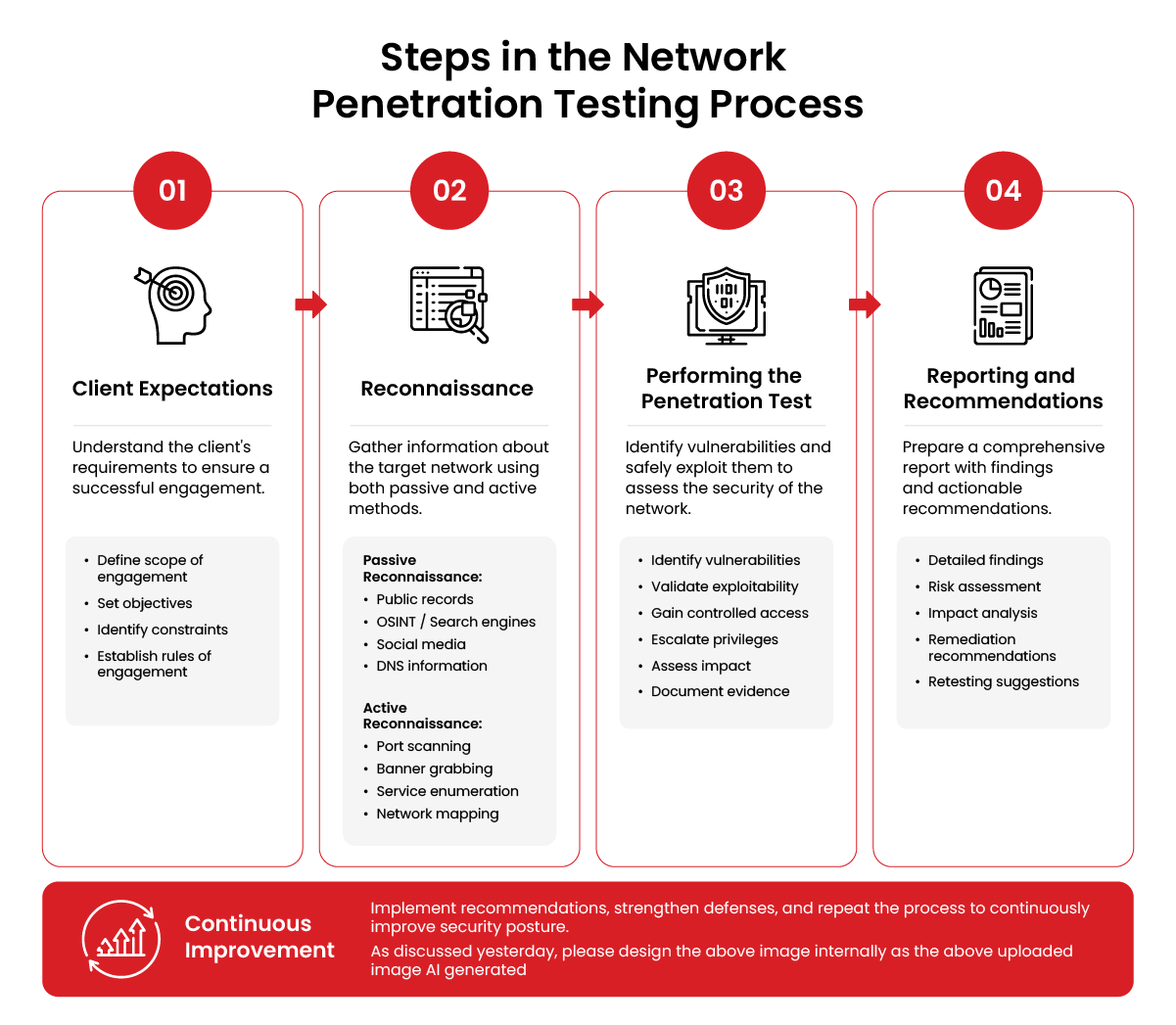
There are four steps in the network penetration testing process:
- Client Expectations: The first step is to understand the client’s expectations. This includes the scope of the engagement, the objectives, and any constraints.
- Reconnaissance: This involves gathering information about the target system and can be accomplished through passive or active methods. Passive reconnaissance requires the tester to collect information about the target system without interacting with it. This can be done by searching public records, social media, and other online resources. Active reconnaissance has the tester interact with the target system to gather information. This can be achieved through port scanning, banner grabbing, and other methods.
- Performing the Network Penetration Test: The next step is to perform the actual penetration test. Doing so includes identifying vulnerabilities and exploiting them to gain access to the system.
- Reporting and Recommendations: In this final step, the security team prepares a detailed report describing the whole testing process. The report should include a list of all identified vulnerabilities and a risk assessment. Recommendations should be made to mitigate the identified risks.
Network Penetration Testing in Modern Enterprise Environments
Today’s enterprise network has multiple layers of security infrastructure, including internal segments, demilitarized zones (DMZs), virtual private networks (VPNs), cloud workloads, and endpoint tools. All of these are connected, and each one of them is a possible route for attackers to exploit.
After analyzing approximately 22,000 security incidents as well as over 12,000 confirmed breaches, it was found that third-party involvement accounted for 30% of incidents, double that of 2024 (Verizon, 2025).
This is precisely why network penetration tests are performed. Scans of perimeters alone can’t tell if the segmentation works as expected, or even how an attack might propagate through an environment once it has breached security at a point of entry. Performing tests on these internal networks is equally important.
Exploited vulnerabilities, as an initial access vector, were involved in 20% of breaches, a 34% increase over the previous year, with edge devices and VPNs among the most common targets (Verizon, 2025). That is just one factor at play as enterprises add more connected components to their systems, such as cloud infrastructure, remote access capabilities, and third-party integrations. It means organizations need to look beyond traditional security testing methods designed to look only at specific segments or systems. They need better insight into the real-world attack paths used in today’s complex network environments.
How CPENT AI Helps Professionals Secure the Modern Enterprise Network
Modern enterprise networks no longer end at the firewall. They span LAN segments, DMZs, VPNs, and layers of endpoint security, and a single security misconfiguration at the boundary between these environments can give an attacker a way in.
CPENT AI, an industry-recognized, advanced penetration testing course, is built around this reality. It places learners inside a realistic enterprise network, complete with LAN segments, DMZs, VPNs, firewalls, and endpoint security: the same layered architecture most organizations run on. It offers five multi-disciplinary network ranges, including a dedicated Active Directory range, with access to 110+ hands-on labs built to mimic real-world scenarios.
Network-Specific Skills the Program Targets
- Bypassing Network Filters: Identifying and evading firewalls, IDS, and segmentation controls.
- Pivoting Through Internal Networks: Navigating from an initial foothold to additional systems and critical assets, the way an attacker would move once inside.
- Double Pivoting Across Disparate Networks: CPENT AI is the first certification in the world that requires learners to access hidden network segments using double pivoting.
- Active Directory Penetration Testing: Practice Kerberoasting and Golden/Silver Ticket attacks to identify weaknesses in Active Directory authentication, escalate privileges, and maintain access across the enterprise network.
Building such skills helps learners navigate a segmented enterprise network under real conditions. Explore the Certified Penetration Testing Professional (CPENT AI) course to know more about the hands-on training in these areas.
FAQs
What is network penetration testing?
Network pentesting is an authorized, simulated cyberattack on an organization’s network infrastructure to identify exploitable vulnerabilities. Ethical hackers use techniques similar to real attackers to assess firewalls, routers, servers, and endpoints, and then report the weaknesses so they can be remediated before malicious actors exploit them.
Why is network penetration testing important?
Network pentesting helps organizations identify security weaknesses, improve compliance, validate security controls, strengthen incident response capabilities, and reduce the risk of data breaches and unauthorized access.
What are the types of penetration testing?
Common types include network penetration testing, web application testing, wireless testing, social engineering, and cloud penetration testing. Tests are also categorized by knowledge level: black box (no prior knowledge), white box (full knowledge), and gray box (partial knowledge of systems).
What is the difference between internal and external penetration testing?
Internal penetration testing assesses systems and security controls from within an organization’s network, while external penetration testing assesses internet-facing systems from outside the network. In short, internal testing evaluates internal exposure, while external testing evaluates external exposure.
What are the commonly used penetration testing tools?
Popular tools include Nmap (network scanning), Metasploit (exploitation framework), Burp Suite (web app testing), Wireshark (packet analysis), Nessus/OpenVAS (vulnerability scanning), John the Ripper/Hashcat (password cracking), and Kali Linux, a distribution bundling many pen testing tools for security professionals.
What are the steps in a network penetration testing process?
A network pentesting process includes defining scope and objectives, reconnaissance, vulnerability identification, controlled exploitation, validation of findings, reporting, and remediation recommendations.
What is perimeter network pentesting?
Perimeter network pentesting aims to evaluate how effectively perimeter security measures prevent, detect, and respond to attackers, as well as to spot flaws in internet-facing assets, such as FTP servers. Perimeter devices and testing include firewalls, routers, IDS, and IPS.
References
PCI Security Standards Council. (2024, June). Payment Card Industry Data Security Standard: Requirement and Testing Procedures, Version 4.0.1. https://docs-prv.pcisecuritystandards.org/PCI%20DSS/Standard/PCI-DSS-v4_0_1.pdf
Verizon. (2025). 2025 Data Breach Investigations Report. https://www.verizon.com/business/resources/reports/2025-dbir-data-breach-investigations-report.pdf