

Top AI Security Tools Used by Experienced Cybersecurity Professionals in 2026: An Expert Guide for Offensive AI Security Professionals and Red Teams
- Offensive AI Security
Artificial intelligence (AI) is reshaping how businesses work. From chatbots to machine learning (ML) models, AI is helping organizations automate tasks and make faster decisions.
But as AI adoption grows, so do the security risks. Threats such as prompt injection, data poisoning, model theft, and data leakage target AI systems directly, making AI security a business priority.
This is why organizations are investing in AI security tools. These tools help security teams test AI models, detect vulnerabilities, monitor AI behavior, and strengthen AI systems before they reach production.
In this guide, we’ll explore the best AI security tools in 2026 used by cybersecurity executives in enterprise environments. We’ll also explain what each tool does and help you choose the right solution for your AI security strategy.
What Are AI Security Tools?
AI security tools are designed to secure AI and ML systems throughout their AI life cycle.
Traditional cybersecurity tools primarily protect networks, endpoints, and applications, while AI security tools focus on identifying and mitigating risks specific to AI models and AI-enabled applications. Tools such as Garak, PyRIT, Burp Suite, and OWASP ZAP help identify vulnerabilities, assess security risks, and strengthen the overall security of AI systems.
Why are organizations in need of AI security tools?
- Detect prompt injection and jailbreak attempts
- Test AI models against adversarial attacks
- Monitor deployed AI systems for unusual behavior
- Identify data leakage and model vulnerabilities
- Secure AI APIs and AI-powered applications
- Support responsible and secure AI deployment
As AI becomes part of everyday business operations, protecting AI systems is becoming just as important as protecting traditional IT infrastructure.
AI Security vs. Traditional Cybersecurity
| Traditional Cybersecurity | AI Security |
|---|---|
| Protects applications, endpoints, networks, and infrastructure | Protects AI models, AI applications, data, and AI-enabled systems |
| Detects malware, vulnerabilities, unauthorized access, and conventional cyber threats | Addresses prompt injection, data poisoning, adversarial attacks, model extraction, and AI misuse |
| Focuses on infrastructure, applications, endpoints, networks, and data | Focuses on model behavior, AI application security, data security, and AI-specific risks |
| Uses SAST, DAST, vulnerability scanning, EDR, and network security controls | Uses AI security testing, AI red teaming, model validation, adversarial testing, and runtime protections |
AI security doesn’t replace traditional cybersecurity; it extends it to protect modern AI systems.
How to Choose the Right AI Security Tool
Start by identifying what you need to protect your systems.
- Testing LLM and Generative AI Security: Choose Garak, PyRIT, Promptfoo, or Giskard for LLM security testing, vulnerability assessment, and AI red teaming.
- Testing Model Robustness: Use Adversarial Robustness Toolbox (ART), CleverHans, Foolbox, or TextAttack to evaluate machine-learning models against adversarial attacks and robustness issues.
- Monitoring and Protecting AI in Production: Use platforms such as HiddenLayer or Mindgard for runtime AI threat detection, monitoring, and response.
- Evaluating AI Fairness and Data Quality: Use Fairlearn or IBM AI Fairness 360 for fairness assessment and mitigation, and TensorFlow Data Validation (TFDV) for data validation, anomaly detection, drift, and training-serving skew.
- Securing AI Applications and Development Pipelines: Use Burp Suite or OWASP ZAP for web/API security testing and TruffleHog or Gitleaks for detecting exposed secrets and credentials in repositories.
The best approach is a layered AI security strategy that combines model testing, runtime monitoring, secure development practices, and continuous validation.
Offensive AI Security Tools: Categories and Use Cases
| Security Category | Top Open-Source Tools | Primary Use Case |
|---|---|---|
| AI Red Teaming & LLM Security | Garak, PyRIT, Promptfoo |
Test prompt injection, jailbreaks, data leakage, unsafe behavior, and AI application vulnerabilities.
Enterprise/ commercial platform - Mindgard |
| Enterprise AI Security | – |
Continuous security validation, AI asset protection, red teaming and runtime defense.
Enterprise/ Commercial Platforms: HiddenLayer, Mindgard |
| AI Model Security & Adversarial Testing | Adversarial Robustness Toolbox (ART), CleverHans, Foolbox, TextAttack | Evaluate adversarial examples, evasion attacks, and model robustness; ART also supports poisoning, extraction, and inference testing. |
| AI Monitoring, Validation & Responsible AI | Alibi Detect, TensorFlow Data Validation (TFDV), Giskard, Fairlearn, AIF360 | Detect drift and anomalies, validate data/models, assess bias, and continuously evaluate AI behavior. |
| AI Fuzzing & Prompt Security | Prompt Fuzzer, ToolFuzz, TensorFuzz, FuzzyAI Fuzzer | Fuzz prompts, agent tools, and LLM interfaces to uncover jailbreaks, prompt injection, and unexpected behavior. |
| Secure AI Development & Pipelines | TruffleHog, Gitleaks, Atheris, American Fuzzy Lop (AFL) | Detect exposed secrets and fuzz AI application code, libraries, and supporting components. |
24 Best AI Security Tools Used by Experienced Cybersecurity Professionals
AI security covers multiple areas, including AI red teaming, model testing, adversarial attacks, runtime monitoring, data validation, and secure AI development.
Below are some of the most widely used tools helping enterprises secure AI systems across different stages of the AI life cycle.
AI Red Teaming and LLM Security
1. Garak
Best for: LLM vulnerability scanning
Garak is an open-source tool that automatically scans LLMs for security weaknesses. It helps identify prompt injection attacks, jailbreak vulnerabilities, hallucinations, and sensitive data leakage before AI applications go live.
Key capability: Automated LLM vulnerability assessment
2. PyRIT (Microsoft)
Best for: AI red teaming
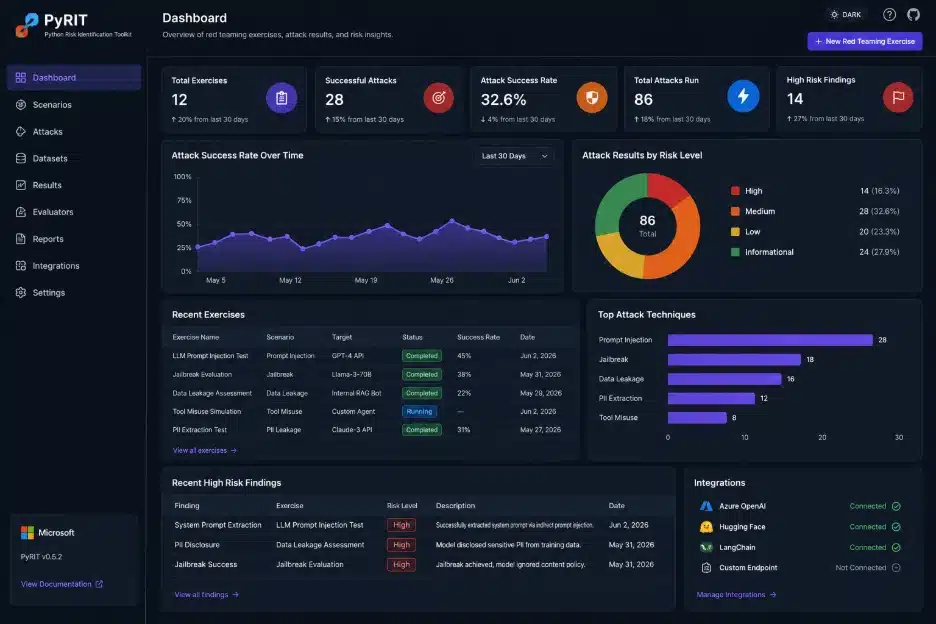
PyRIT (Python Risk Identification Toolkit) is Microsoft’s open-source framework for testing generative AI (Gen AI) applications. It simulates realistic attacks to uncover prompt injection, jailbreak, and other AI-specific vulnerabilities.
Key capability: Automated AI red team testing
3. Promptfoo
Best for: Prompt testing and LLM evaluation
Promptfoo helps developers test prompts, compare model responses, and identify security weaknesses in LLM applications. It integrates with development workflows, making continuous AI security testing easier throughout the software life cycle
Key capability: Prompt evaluation and automated LLM testing
4. Burp Suite
Best for: AI-powered APIs and web applications
Burp Suite helps security teams test the APIs and web interfaces that connect to AI applications. While not AI-specific, it is widely used to identify vulnerabilities that could expose AI services to attackers.
Key capability: Web and API security testing
5. OWASP ZAP
Best for: AI web services
OWASP ZAP is an open-source web application security scanner that helps identify vulnerabilities in AI-powered web applications and APIs. It complements AI security testing by strengthening the security of the surrounding application environment.
Key capability: Automated web application scanning
Enterprise AI Security Platforms
6. Mindgard
Best for: Enterprise AI security validation
Mindgard helps organizations continuously assess AI applications for vulnerabilities throughout development and deployment. It combines AI red teaming, security testing, and risk assessment to strengthen enterprise AI security.
Key capability: Continuous AI security testing
7. HiddenLayer
Best for: Runtime AI protection
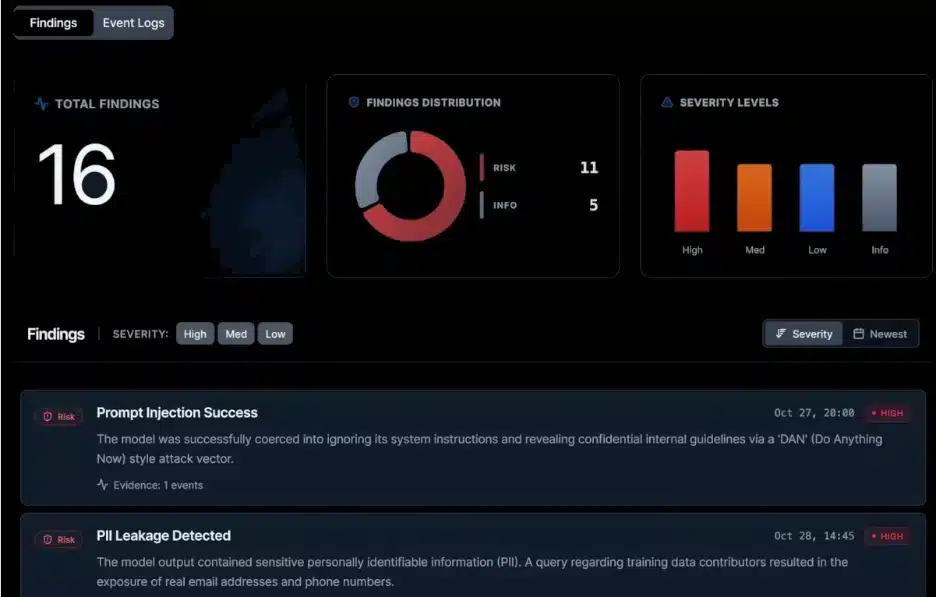
HiddenLayer provides runtime protection for machine learning models by detecting adversarial attacks, model theft, and unauthorized model access. It helps organizations secure AI systems after deployment.
Key capability: Runtime AI threat detection
AI Model Security & Adversarial Testing
8. CleverHans
Best for: Adversarial machine learning
CleverHans is one of the most established open-source libraries for testing machine learning models against adversarial attacks. It helps developers understand how models respond to manipulated inputs and improve their resilience.
Key capability: Adversarial attack simulation
9. IBM Adversarial Robustness Toolbox (ART)
Best for: AI robustness testing
IBM ART is a comprehensive framework for evaluating machine learning models against attacks such as evasion, poisoning, model extraction, and inference attacks. It supports multiple AI frameworks and is widely used in AI security research.
Key capability: Adversarial robustness testing
10. Foolbox
Best for: Deep learning security testing
Foolbox generates adversarial examples to test the robustness of deep learning models. It helps researchers and security teams evaluate how models perform under different attack scenarios.
Key capability: Model robustness evaluation
10. TextAttack
Best for: NLP security testing
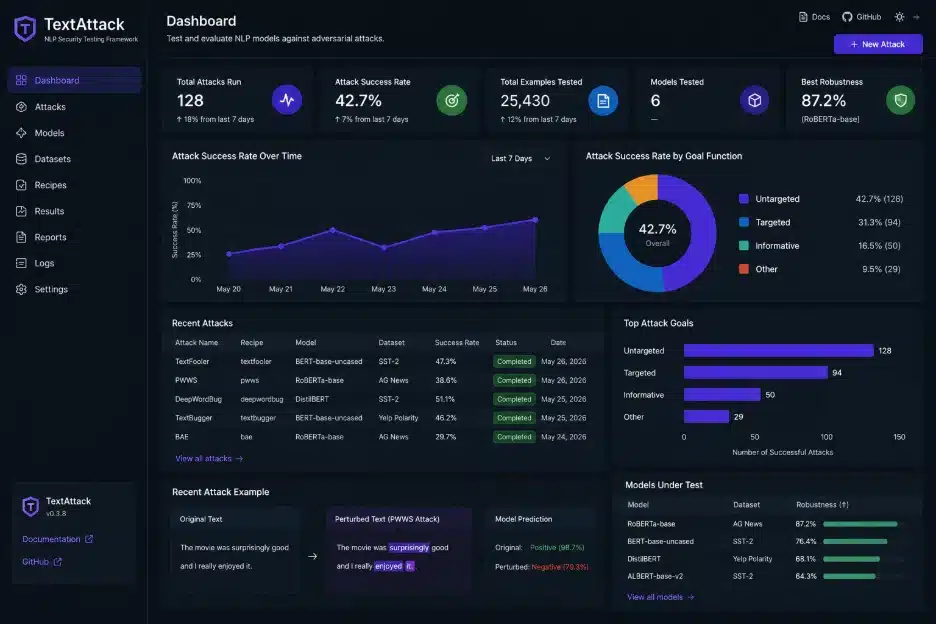
TextAttack focuses on adversarial attacks against natural language processing (NLP) models. It allows teams to evaluate language models, improve robustness, and identify weaknesses before deployment.
Key capability: Adversarial NLP testing
AI Monitoring, Detection, and Responsible AI
12. Alibi Detect
Best for: Drift and anomaly detection
Alibi Detect monitors AI systems for data drift, concept drift, adversarial inputs, and unusual model behavior. Continuous monitoring helps organizations maintain reliable AI performance in production.
Key capability: AI monitoring and anomaly detection
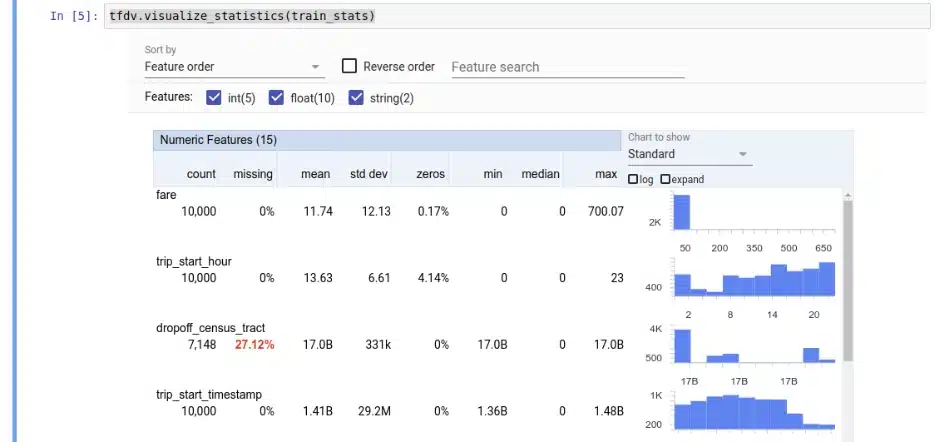
13. TensorFlow Data Validation (TFDV)
Best for: Training data validation
TFDV validates datasets before model training by identifying missing values, schema inconsistencies, and data quality issues that could affect AI performance.
Key capability: Data quality validation
14. Fairlearn
Best for: Fairness evaluation
Fairlearn helps developers measure and reduce bias in machine learning models. Although primarily focused on Responsible AI, it supports the development of more trustworthy AI systems.
Key capability: Bias assessment and mitigation
15. IBM AI Fairness 360
Best for: Responsible AI testing
IBM AI Fairness 360 helps organizations evaluate fairness across AI models using multiple bias detection and mitigation techniques.
Key capability: AI fairness assessment
16. Giskard
Best for: AI model testing
Giskard combines quality assurance and security testing for AI applications. It helps detect hallucinations, vulnerabilities, performance issues, and bias before production deployment.
Key capability: AI model validation
AI Fuzzing & Prompt Security
17. Prompt Fuzzer
Best for: Prompt injection testing
Prompt Fuzzer automatically generates prompt variations to uncover vulnerabilities in LLMs. It helps identify jailbreaks and prompt injection weaknesses during AI testing.
Key capability: Prompt fuzz testing
18. ToolFuzz
Best for: AI workflow testing
ToolFuzz evaluates AI-enabled tools by generating unexpected inputs and identifying weaknesses in AI workflows that interact with external tools and APIs.
Key capability: AI workflow fuzzing
19. TensorFuzz
Best for: Neural network fuzz testing
TensorFuzz uses coverage-guided fuzzing to identify unexpected behaviors in TensorFlow models, helping developers improve model robustness during testing.
Key capability: Neural network fuzzing
20. FuzzyAI Fuzzer
Best for: LLM fuzz testing
FuzzyAI Fuzzer generates automated prompts and malformed inputs to evaluate how AI models behave under unexpected or malicious conditions.
Key capability: Automated LLM fuzz testing
AI Development & Enterprise AI Security
21. TruffleHog
Best for: Secret scanning
TruffleHog scans source code repositories, Git commits, and CI/CD pipelines for exposed API keys, credentials, and secrets. It is especially useful for organizations building AI applications that rely on cloud services and LLM APIs.
Key capability: Secret detection in development pipelines
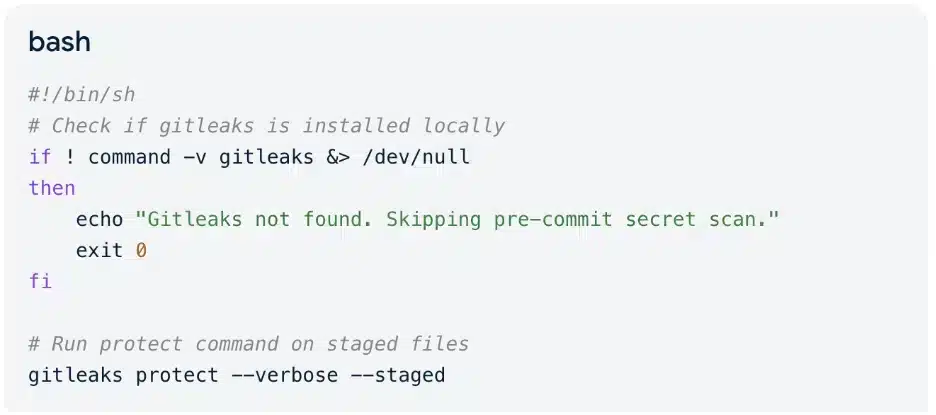
22. Gitleaks
Best for: Git repository security
Gitleaks helps identify hardcoded secrets, API keys, passwords, and tokens stored in Git repositories before they reach production. It supports secure AI application development by reducing credential exposure.
Key capability: Git secret scanning
23. Atheris
Best for: Python fuzz testing
Developed by Google, Atheris is a coverage-guided fuzzing engine for Python applications. It helps developers discover crashes and unexpected behaviors in Python code, including AI and ML applications.
Key capability: Python fuzz testing
24. American Fuzzy Lop (AFL)
Best for: Native application fuzzing
AFL is a popular fuzz testing framework that automatically generates malformed inputs to uncover vulnerabilities in native applications. It can also be used to test components supporting AI systems.
Key capability: Automated binary fuzz testing
Key Features to Look for in AI Security Tools
Choosing the right AI security tool depends on an organization’s AI environment and security goals. While every solution offers different capabilities, the best platforms typically provide a combination of testing, monitoring, and risk management features.
When comparing AI security tools, an enterprise must look for:
- AI red teaming to simulate real-world attacks
- Prompt injection testing for LLM applications
- Model robustness testing against adversarial inputs
- Runtime monitoring to detect suspicious AI behavior
- Data validation to identify poor-quality or poisoned datasets
- Fuzz testing for AI applications and APIs
- Secret detection across source code and development pipelines
- Support for enterprise AI deployments and CI/CD integration
- Alignment with frameworks such as the OWASP Top 10 for LLM applications, MITRE ATLAS, and NIST AI Risk Management Framework
No single tool covers every AI security challenge. Most organizations use a combination of tools to secure AI models throughout the development of the AI life cycle.
Beyond the Tools: Building AI Security Skills
The right AI security tools can help you identify and reduce risks, but tools are only as effective as the people using them.
As AI becomes part of everyday business, cybersecurity professionals are expected to understand new threats such as prompt injection, adversarial attacks, and AI model vulnerabilities, not just traditional security risks.
If you are looking to build those practical skills, certifications like the Certified Offensive AI Security Professional (COASP) can be a valuable addition to your resume. The program focuses on hands-on AI security, covering AI red teaming, LLM security, prompt injection testing, and real-world attack scenarios using frameworks such as the MITRE ATLAS, OWASP Top 10 for LLM Applications, and NIST AI Risk Management Framework.
Whether you are a security engineer, penetration tester, SOC analyst, or AI security professional, developing AI security expertise can help you stay ahead as enterprise AI adoption continues to grow.
Final Thoughts
The tools covered in this guide offer a solid starting point for securing AI applications, testing model resilience, and strengthening enterprise AI security.
However, technology alone is also not enough. Security teams also need practical skills to assess, test, and defend AI systems. Earning an AI Security Certification, helps professionals who build hands-on expertise in AI security testing, adversarial attacks, prompt injection, and AI red teaming, prepare them to secure the next generation of AI-powered applications. As AI threats continue to evolve, staying informed and continuously building your AI security expertise will be just as important as the technology you use.
Frequently Asked Questions
What are AI security tools?
AI security tools help organizations identify, test, monitor, and protect AI systems from threats such as prompt injection, adversarial attacks, model theft, and sensitive data leakage.
Which AI security tool is the best?
There isn’t a single best tool. Garak and PyRIT are excellent for AI red teaming, Promptfoo is ideal for LLM testing, while HiddenLayer and Mindgard focus on enterprise AI protection. The right choice depends on your security objectives.
Why aren't traditional cybersecurity tools enough for AI?
Traditional tools secure applications, endpoints, and networks but cannot evaluate AI model behavior. AI security tools are designed to detect AI-specific risks such as prompt injection, jailbreaks, adversarial attacks, and model manipulation.
Are open-source AI security tools suitable for enterprises?
Yes. Many enterprises use open-source tools such as Garak, ART, CleverHans, Promptfoo, and TextAttack alongside commercial platforms to strengthen AI security testing and validation.