
AI and Cybersecurity: Current Adoption Trends
But here is what most people do not talk about: implementing AI in cybersecurity is one thing; ensuring that AI works effectively is another.
The Role of AI in Cyber Security: What AI Is Good At
Threat Detection and Anomaly Spotting
Automating Repetitive SOC Tasks
Predictive Risk Scoring
The Other Side: AI in the Hands of Attackers
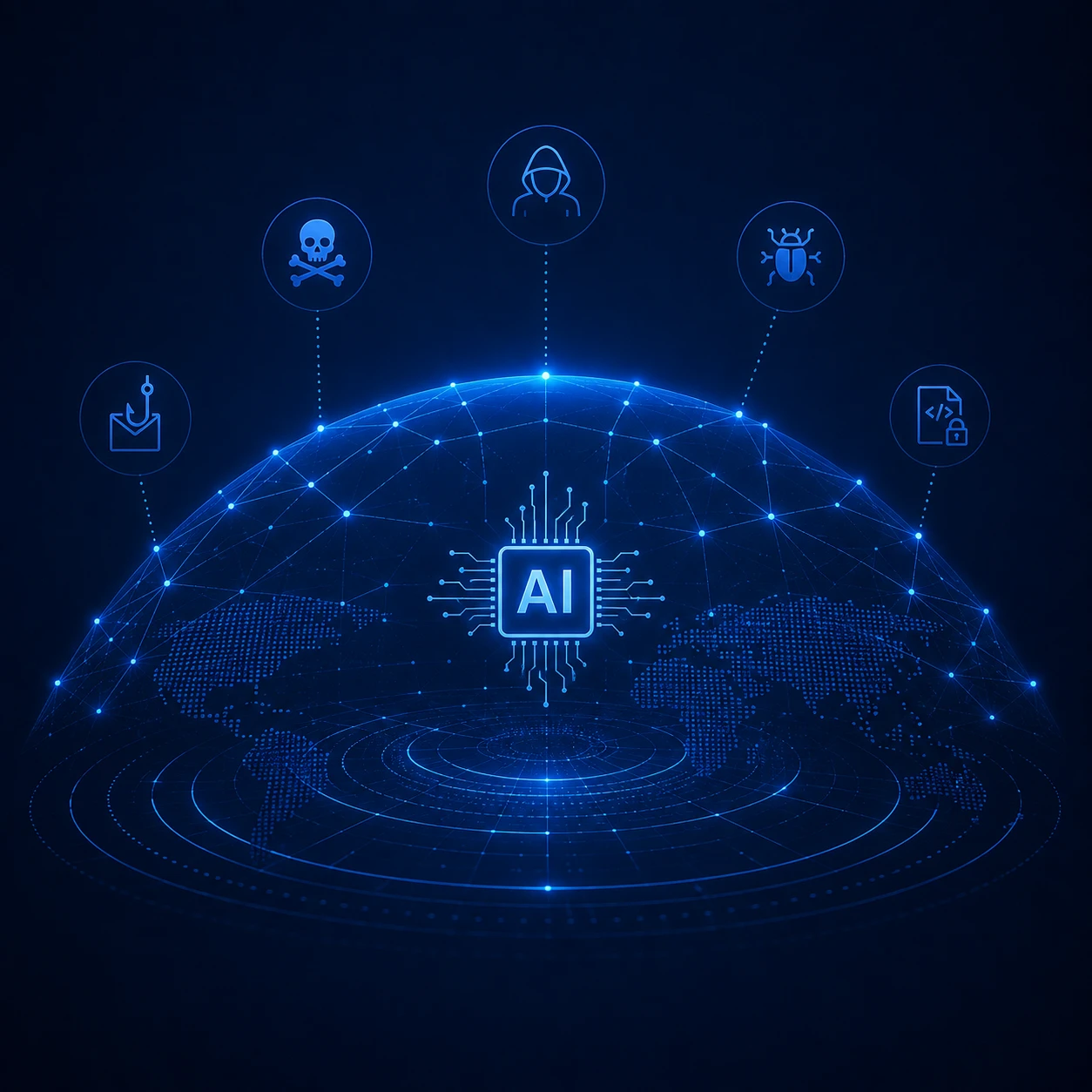
AI-Generated Phishing and Social Engineering
AI-assisted phishing went from a rising concern to the leading threat. There has been an alarming 14x increase in these types of attacks in December 2025 compared to January 2025 (Hoxhunt, 2026). These numbers reflect the ability of generative AI tools to create grammatically accurate, contextually relevant messages indistinguishable from those sent by genuine senders.
Deepfake-Driven Fraud
Deepfake-enabled fraud is no longer a theoretical risk, with 62% of organizations having experienced a deepfake attack involving social engineering or the exploitation of automated processes (Gartner, 2025). Deepfakes are increasingly used to impersonate executives through video or voice calls to authorize fraudulent schemes that can result in financial and reputational damage.
Adaptive, Evasive Malware
Why This Raises the Stakes for Defenders
Key Risks and Limitations of AI in Cybersecurity
False Positives, False Negatives, and the Absence of Contextual Judgment
Adversarial AI Attacks and Model Poisoning
Compliance, Explainability, and Accountability Gaps
Will Cybersecurity Be Replaced by AI? The Honest Answer
Future-Proof Your Cybersecurity Career with AI Skills
- Prompt-literate threat hunting (directing AI tools during investigations, not just running scanners)
- Day-to-day AI-tool fluency
- AI governance and ethics, since regulators now expect security teams to explain how their AI systems make decisions.
CEH AI : AI-Enhanced Ethical Hacking
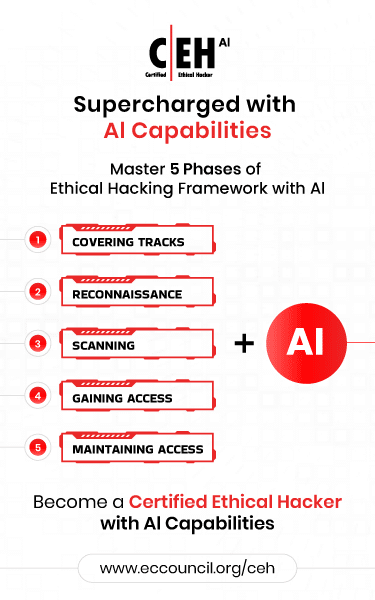
The Certified Ethical Hacker (CEH AI) program integrates AI across all five phases of ethical hacking. Learners get hands-on experience with tools such as ShellGPT, ChatGPT, DeepExploit, and more for AI-assisted command generation, OSINT, and exploit validation, and learn how to discover vulnerabilities in AI systems using the OWASP Top 10.
CPENT AI : Advanced Pen Testing with AI-Assisted Attack Simulation
The Certified Penetration Testing Professional (CPENT AI) program applies AI across all phases of penetration testing, including reconnaissance, exploitation, and post-exploitation. It provides five cyber ranges, including Active Directory (AD), IoT, and binaries.
CAIPM: Adoption, Execution, and Operationalization of AI Programs
The Certified AI Program Manager (CAIPM) certification course is built for professionals who lead AI adoption, including strategy, risk management, and measurable ROI, at the organizational level. It helps leaders bridge the gap between AI capabilities and business outcomes.
COASP: Offensive AI Security and Red Teaming
The Certified Offensive AI Security Professional (COASP) certification course focuses on preparing professionals to understand attacks on AI systems using AI red teaming techniques, including prompt injection, model extraction, data poisoning, and adversarial ML attacks against LLMs and AI agents. The course is aligned with MITRE ATLAS and the OWASP Top 10 for LLM applications.
CRAGE: AI Governance and Ethics
The Certified Responsible AI Governance & Ethics (CRAGE) certification course covers AI compliance and governance, including frameworks and standards such as NIST AI RMF, ISO/IEC 42001, the EU AI Act, and GDPR. It is built for professionals who want to lead AI accountability within the enterprise and demonstrate to regulators that an organization’s AI use is transparent and defensible.
Parting Thoughts
Frequently Asked Questions
Will AI take over cybersecurity jobs?
There is no evidence of that yet. While AI can automate and streamline many repetitive, high-volume tasks, such as correlating logs or triaging an initial alert, it cannot replace the need for cybersecurity professionals to make judgment calls, lead incident responses, or understand the business context.
What are the key risks and limitations of AI in cybersecurity?
Limitations of using AI for cybersecurity include false positives and negatives due to the lack of business context in many AI models. AI security threats include adversarial attacks and training data poisoning that target the AI system itself, as well as issues arising with compliance due to the limitations of explainability. Data privacy and compliance are further risks.
Which AI in cybersecurity course should I consider?
That depends on where you are in your career path and which area of AI security you would prefer to specialize in. EC-Council offers a wide range of AI certifications, from CEH AI for offensive security to CAIPM for AI program management. Choosing the right one comes down to whether you want to work in offensive, governance-led, or leadership-focused AI fields.
Do AI threats pose a bigger risk than their benefits?
Even if professionals or organizations choose not to use AI in cybersecurity, there is no stopping threat actors from leveraging it for malicious gains. Hence, there is no question of weighing the risks versus the benefits in this scenario. Individuals or organizations cannot avoid AI-related risks by choosing not to use AI. What is required are governance measures and AI skills enhancement to ensure AI threats do not pose a big risk.
References
Ahi, K. & Valizadeh, S. (2026, July 08). Large Language Models (LLMs) and Generative AI in Cybersecurity and Privacy: A Survey of Dual-Use Risks, AI-Generated Malware, Explainability, and Defensive Strategies. arXiv. https://arxiv.org/abs/2607.06963
SOC-CMM. (2026, May). SOC Maturity Report. https://www.soc-cmm.com/img/upload/files/66-soc-maturity-report-2026.pdf