
AI and ML-powered incident response helps organizations detect, analyze, and respond to cyberattacks across OT, IoT, and IIoT environments by automating threat detection, prioritizing incidents, and enabling faster, more accurate responses.
- AI and ML can accelerate threat detection, triage, and incident response in OT, IoT, and IIoT environments.
- Default credentials and security misconfigurations are common security issues that can contribute to attacks.
- The strongest security outcomes can come from combining AI automation with human expertise.
Artificial intelligence (AI) and machine learning (ML) have emerged as critical technologies for strengthening incident response, attack detection, and threat prevention across operational technology (OT), Internet of Things (IoT), and Industrial Internet of Things (IIoT) environments. As industrial systems become increasingly connected, traditional security approaches face challenges related to growing complexity, scale, and evolving cyberthreats.
Security Challenges in Connected Industrial Environments
OT and IIoT environments present unique security challenges due to the scale and diversity of connected devices. The infrastructure of these environments often comprises equipment from multiple manufacturers, which may use different communication protocols, firmware designs, and data formats.
Security gaps are common due to vendor fragmentation, inconsistent standards, and resource-constrained devices. Some resource-constrained sensors and embedded systems may lack sufficient computational capacity to support advanced encryption methods and security controls. As a result, implementing security updates and managing patches across large deployments can be difficult.
At the same time, threat actors may exploit vulnerabilities arising from device misconfigurations, insecure protocols, and weaknesses in system design. These factors collectively increase the complexity of incident detection, response, and risk management in industrial environments.
Incident Response (IR) Pain Points
Incident response teams often face significant visibility challenges in OT and IIoT environments. One common issue is a data blind spot caused by incomplete device logs, unavailable application programming interfaces (APIs), and vendor-specific implementations that differ widely. Comprehensive monitoring can be difficult to achieve due to the distributed nature of industrial infrastructure. Devices, gateways, and remote systems are frequently spread across multiple operational sites, limiting centralized visibility.
The absence of centralized logging further complicates security operations. Logs generated by different devices may be stored in separate locations or in incompatible formats, making it difficult to obtain a unified view of security events across the environment. These limitations can contribute to increased false positives, slower investigations, and delays in threat containment, creating significant operational challenges for incident response teams.
The Expanding Threat Landscape
Cyberthreats targeting industrial environments continue to evolve. Attackers are moving beyond basic reconnaissance activities and are focusing on disrupting operations, exploiting industrial systems, and targeting critical infrastructure. Numerous attacks against industrial environments have been documented over the years, highlighting the persistent risks facing OT, IoT, and industrial control systems (ICS). In response, security agencies and organizations, including CISA, have published guidance, frameworks, and best practices designed to improve the security posture of industrial environments.
ICS Exposure on the Internet
ICS continue to be exposed to the public internet, creating opportunities for threat actors to identify and target these systems. Internet scanning platforms can identify internet-accessible devices and services that use industrial protocols such as Modbus and DNP3, demonstrating that some industrial infrastructure is reachable from the internet and potentially vulnerable to exploitation. This reality reinforces the need for stronger monitoring, proactive threat detection, and advanced defensive technologies to reduce organizational risk.
Limitations of Manual Incident Response
The scale and complexity of modern industrial environments can strain traditional, manual incident response processes. Security teams are often required to manage large asset inventories, process high volumes of alerts, and investigate complex attacks. However, organizations may have limited access to skilled analysts and subject matter experts. As a result, detection and response cycles may be delayed, and recovery efforts may become more costly and resource-intensive. These challenges have highlighted the need for greater automation and intelligence within security operations.
How AI Enhances Cybersecurity Operations
Human expertise remains important throughout the process, particularly when strategic decisions, incident validation, and response actions are required. AI can serve as a force multiplier that helps incident response teams operate more effectively in complex environments.
Applying the Data Science Life Cycle to Threat Detection
A cybersecurity research initiative conducted in collaboration with the Global Cyber Alliance explored the application of machine learning to IoT threat detection (Global Cyber Alliance, 2023).
The project leveraged data sets generated through honeypot deployments, which contained information related to IoT attacks, login attempts, commonly abused protocols, and source geolocation data. This information provided valuable insights into attacker behavior and attack trends (Buja et al., 2024a, 2024b).
The research was conducted using a structured data science life cycle. The first phase focused on understanding, cleaning, and preparing the data for analysis. The second phase involved model design, machine learning implementation, and performance evaluation.
Through this approach, machine learning models were developed and tested to identify malicious activity, distinguish attack patterns, and improve threat detection capabilities within IoT environments.
Exploratory Data Analysis
An exploratory data analysis (EDA) was conducted to identify patterns within a large IoT attack data set. The analysis revealed a significant number of successful login attempts that relied on default usernames and passwords.
More than 23 million successful login events were identified, with a substantial portion linked to factory-default credentials (Buja, 2026). These credentials, often inherited from device manufacturers and left unchanged after deployment, were found to be a major security weakness.
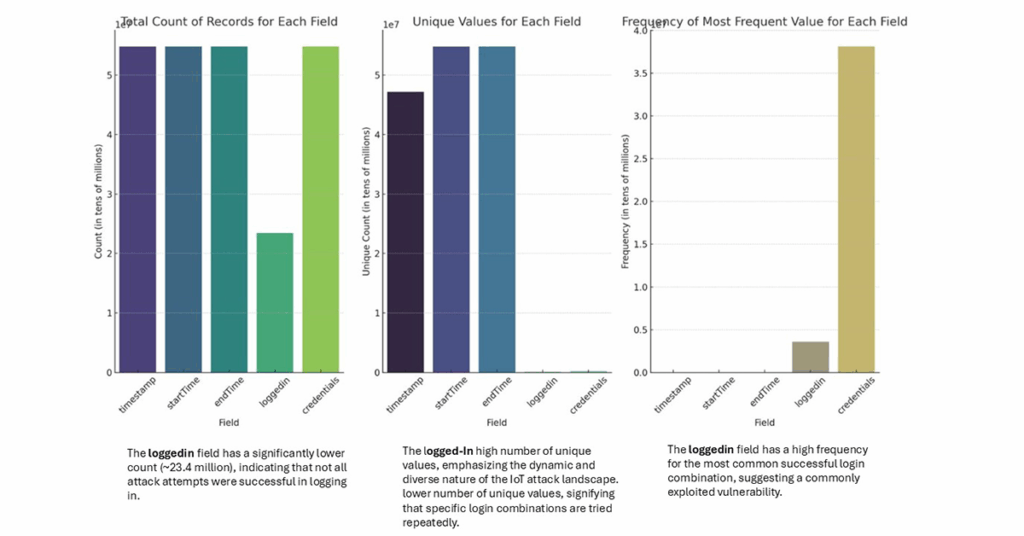
Figure 1: Exploratory data analysis (EDA). The image indicates that many login attempts fail, while repeated successful login combinations highlight commonly exploited authentication vulnerabilities.
The findings highlighted several key observations:
- Default credentials remain a primary attack vector.
- Certain username-password combinations are repeatedly targeted by attackers.
- Many attack attempts fail, indicating that not all credentials are successfully compromised.
- Login-related vulnerabilities continue to pose significant risks across IoT environments.
The analysis reinforced the importance of credential management and secure device configuration as foundational security controls.
Feature Selection and Model Development
Following the data analysis phase, relevant features were selected to support machine learning model development. Based on the selected features, a supervised learning approach was adopted, and the data sets were split into training and test sets to evaluate model performance. Multiple algorithms were assessed to determine their effectiveness in identifying malicious activity and distinguishing attacks from legitimate behavior.
Model Performance and Results
The machine learning models demonstrated strong performance across key evaluation metrics, including accuracy, precision, recall, and F1 scores. The results indicated that attacks could be identified with high accuracy and precision while maintaining low false-positive rates. The models also exhibited a balanced ability to detect malicious activity without generating excessive false alarms. These findings suggest the potential of machine learning to enhance IoT security by enabling faster, more accurate threat detection at scale.
What This Means for IR
Even modest improvements in detection accuracy can significantly improve incident response operations. AI-driven analysis helps reduce analyst fatigue by filtering large volumes of alerts and prioritizing the most relevant events. Key benefits include:
- Faster threat detection
- Reduced false positives
- Improved alert prioritization
- Behavior-based threat identification
- More proactive security operations
Rather than reacting to incidents after they occur, organizations can shift toward earlier detection and prevention.
Integrating ML Into the IoT World
Machine learning models can be integrated into security information and event management (SIEM) platforms, case management systems, and threat intelligence workflows. These integrations enable advanced detection capabilities such as:
- Geographic anomaly detection
- Login behavior analysis
- Traffic spike identification
- Threat pattern recognition
By incorporating these capabilities into existing security processes, organizations can improve overall visibility and response effectiveness.
Introducing the IIoT Guardian Concept
marks and spencersBuilding on previous research, a prototype architecture known as IIoT Guardian was developed to explore real-time industrial threat detection. The concept combines:
- Edge and cloud computing
- Continuous machine learning
- Real-time anomaly detection
- Automated threat analysis
Security monitoring is applied throughout the data life cycle, from sensors and gateways to storage systems and analytics platforms. Trained machine learning models are used to analyze operational data and generate actionable insights that can be integrated into security operations centers (SOCs) and SIEM platforms. Here, the objective is not to eliminate human involvement but to provide analysts with better visibility, faster detection, and more effective response capabilities.
Expanding Research Beyond IoT Security
Additional research initiatives have focused on machine learning applications across multiple domains, including cybersecurity. These include:
- Wireless sensor network (WSN) attack detection
- Sinkhole and wormhole attack identification
- Transportation and traffic prediction models
- Healthcare cybersecurity frameworks
- Governance and data protection models for healthcare environments
Several models have been developed and studied to improve detection accuracy and strengthen security across these specialized areas.
AI Across the Incident Response Life Cycle
AI can support every stage of the incident response process, including:
- Detection
- Alert enrichment
- Correlation and prioritization
- Investigation
- Containment
- Recovery
- Lessons learned
One of the most significant benefits is alert reduction. Security teams may face high volumes of alerts daily, creating operational overload.
Machine learning can identify patterns, score behavior, and filter large amounts of low-value noise before alerts reach analysts. This enables teams to focus on a smaller number of high-priority events that require human investigation.
While AI can dramatically reduce workloads, human expertise remains essential for validation, decision-making, and response execution.
Blueprint for AI-Enhanced IR
An effective AI-enhanced incident response strategy should include:
- Comprehensive asset inventory
- Centralized OT and IoT logging
- Mature data pipelines
- Machine learning model integration
- Automated response playbooks
- Continuous model retraining
Implementation can be supported through existing SOC technologies, SIEM platforms, machine learning frameworks, and lightweight edge computing solutions.
A hybrid approach that combines AI capabilities with human expertise remains the most effective model for operational success.
The Future of AI in Incident Response
The future of incident response is expected to be shaped by increasingly intelligent and autonomous systems. Key areas of development include:
- Autonomous security agents
- Continuous self-learning models
- Digital twins for OT environments
- Predictive maintenance and security integration
- AI-powered industrial honeypots
- Proactive threat prevention strategies
These developments will help organizations move from reactive defense toward predictive and adaptive security operations.
Conclusion
The growing complexity of industrial environments is placing increasing pressure on traditional incident response processes. AI and machine learning offer a practical path toward faster detection, improved visibility, and more efficient response at scale. Research findings demonstrate that machine learning can successfully identify attack patterns, reduce false positives, and strengthen security operations across OT, IoT, and IIoT environments.
However, the future of cybersecurity will not be driven by AI alone. The greatest impact can be achieved through collaboration between technology, security practitioners, researchers, and industry partners. By combining human expertise with intelligent automation, organizations can build more resilient and proactive cyber defense capabilities.
Frequently Asked Questions
AI learns normal system behavior and identifies genuine anomalies, helping filter out low-risk alerts. This reduces alert fatigue and allows analysts to focus on real threats.
AI assists with threat detection, alert enrichment, investigation, prioritization, containment, recovery, and post-incident analysis. It helps security teams complete these activities more efficiently.
AI helps detect threats faster by analyzing large volumes of security data, identifying anomalies, and prioritizing high-risk alerts. This enables security teams to respond more quickly and efficiently.
References
Global Cyber Alliance. (2023, September 7). GCA and ICT Academy partner to track data on IoT security in the Balkans. https://globalcyberalliance.org/partnership-ict-academy-balkans/
Buja, A., et al. (2024a). Enhancing IoT security: Development and evaluation of a predictive machine learning model for attack detection. Advances in Artificial Intelligence and Machine Learning, 4(3), 145. https://www.oajaiml.com/uploads/archivepdf/486343145.pdf?
Buja, A., et al. (2024b). Innovative machine learning model design for predictive IoT security attacks. Advances in Artificial Intelligence and Machine Learning, 4(2), 139. https://www.oajaiml.com/uploads/archivepdf/640142139.pdf?
Buja, A. (2026, February 18). Incident response with AI & ML for OT/IoT/IIoT attack detection & prevention. https://www.eccouncil.org/cybersecurity-exchange/cyber-talks/incident-response-with-ai-ml-for-ot-iot-iiot-attack-detection-prevention/
Tags
About the Author

Prof. Atdhe Buja
Assistant Professor, Commonwealth University of Pennsylvania
Atdhe Buja is an Assistant Professor of Computer Science, Digital Forensics, and Cybersecurity at the Commonwealth University of Pennsylvania, USA (Bloomsburg University). Atdhe is a world-renowned cybersecurity expert with decades of experience. He is an EC-Council Instructor (CEI) and CEH, Microsoft IT Professional, and Oracle Administrator for RDBMS, and a leading authority on information technology, Industrial IoT, and ICS/SCADA cybersecurity. His research work focuses on cybersecurity countermeasures for Industrial IoT, IoT security, ICS/SCADA infrastructures, WSNs, cybersecurity of ML and AI, and database management systems. He is the author of multiple books, including ‘Cybersecurity of Industrial Internet of Things (IIoT) and AI and ML-Driven Cybersecurity: Industrial IoT and WSN with Python Scripting.’