
OpenAI-powered incident response leverages LLMs and RAG to automate investigations, correlate threat intelligence, reconstruct attack chains, and improve incident response efficiency and accuracy.
- AI accelerates incident response through faster script analysis, log investigation, and attack-chain reconstruction.
- Azure OpenAI enables automated security workflows for improved containment and recovery decisions.
- RAG enhances AI-driven security investigations with organizational knowledge and current threat intelligence.
As cyberthreats continue to evolve in sophistication and scale, organizations are increasingly challenged to detect, investigate, and respond to incidents within shrinking time frames. Security teams are often required to analyze vast quantities of logs, alerts, and threat intelligence while simultaneously making critical decisions that impact business operations. Traditional incident response processes, although effective, are frequently constrained by the limited availability of skilled personnel and the growing complexity of modern attack chains.
Artificial intelligence (AI) is emerging as a transformative force within security operations. Large language models (LLMs), including those used in OpenAI-powered solutions, are enabling analysts to investigate incidents more efficiently, automate repetitive tasks, and gain deeper insights into security events. From explaining suspicious scripts to assisting with threat hunting and generating response recommendations, AI is rapidly becoming an integral component of modern cybersecurity operations. This article explores how AI technologies can enhance incident response through enterprise AI assistants, integrated security copilots, OpenAI workflows, and retrieval-augmented generation (RAG).
How Generative AI Supports Security Operations
Generative AI tools have already become valuable resources for security professionals during day-to-day investigations. Security analysts frequently encounter unfamiliar scripts, suspicious commands, encoded payloads, and malware-related artifacts that require rapid analysis. Traditionally, these investigations demanded significant manual effort and specialized expertise. With solutions such as Microsoft 365 Copilot, security teams can leverage AI to interpret complex technical information in a matter of seconds. Commands, PowerShell scripts, and suspicious code snippets can be submitted for analysis, allowing detailed explanations to be generated automatically.
This capability is particularly useful during incident response activities where analysts must quickly understand the purpose and potential impact of suspicious code. Rather than manually reviewing lengthy scripts line by line, AI-generated explanations can provide immediate context regarding functionality, behavior, and possible security implications. Another significant advantage is the ability to generate queries, detection logic, and automation scripts. Security professionals can request assistance in creating search queries, incident investigation workflows, or security controls. While generated outputs should always be validated due to the possibility of inaccuracies or hallucinations, substantial productivity gains can be achieved through AI-assisted content generation.
A major consideration in cybersecurity is data privacy. Microsoft 365 Copilot Chat provides Enterprise Data Protection (EDP) for supported organizational users, and Microsoft states that prompts, responses, and Microsoft Graph data are not used to train foundation models. Copilot Chat also respects existing organizational permissions and controls. When web grounding is enabled, search queries are handled separately through Bing and are subject to its own data-handling practices. Organizations should therefore consider their security, compliance, and data-handling requirements when using Copilot Chat for sensitive investigations.
The value of AI within security operations lies not in replacing human analysts but in accelerating understanding and reducing the time required to investigate unfamiliar or complex technical artifacts.
How Security Copilot Supports Incident Response
While general-purpose AI assistants can support security tasks, dedicated security-focused AI platforms offer a deeper level of integration with existing security environments. Microsoft Security Copilot (Security Copilot) and similar solutions from major cybersecurity vendors are designed specifically for security operations (Microsoft, 2026). Rather than relying only on manual data uploads, integrated platforms can use telemetry, logs, alerts, and threat intelligence from supported, connected security products and configured data sources.
This integration enables AI to analyze information at a scale that would be difficult for human analysts to achieve manually. Organizations routinely generate large volumes of security events across endpoints, networks, cloud environments, and applications. AI-powered security assistants can summarize and correlate signals to help analysts understand patterns and attack sequences. One of Security Copilot’s most valuable capabilities is incident summarization. Complex incidents often involve numerous alerts generated across multiple systems, and determining how these alerts relate to one another can be time-consuming.
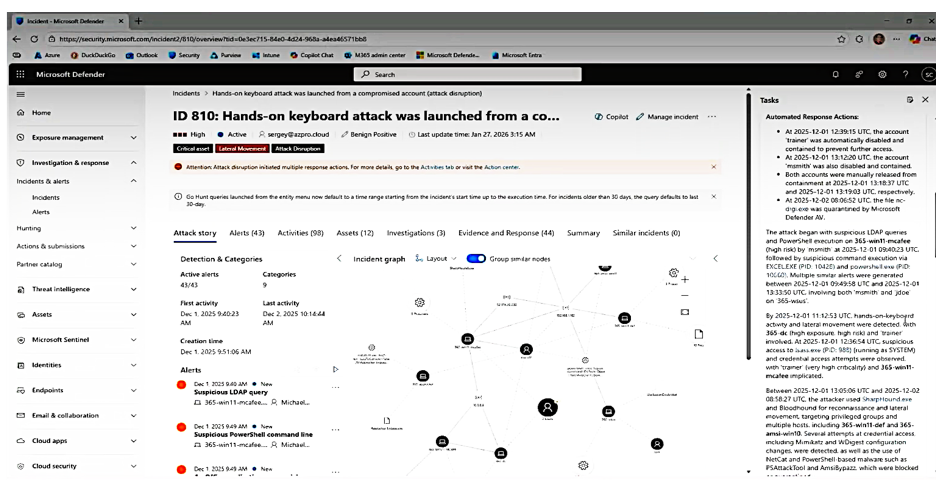
Figure 1. Microsoft Defender incident view showing the incident graph and automated response actions (Chubarov, 2026).
AI can simplify this challenge by reconstructing the attack narrative. Rather than presenting isolated alerts, Security Copilot can identify, based on available incident data, how the attack originated, which assets were affected, which user accounts were involved, and how the attacker progressed through the environment.
For example, an attack may begin with a malicious Microsoft Excel document that launches a PowerShell command. Subsequent actions may include credential theft, lateral movement, privilege escalation, reconnaissance activities, and persistence attempts. AI can automatically summarize these stages and present them as a coherent attack timeline.
In addition to investigation support, Security Copilot can provide actionable response recommendations. Depending on the incident and available integrations, suggested actions may include:
- Isolating compromised devices
- Disabling affected accounts
- Resetting passwords
- Blocking malicious indicators
- Conducting forensic analysis
- Initiating containment procedures
These recommendations can help analysts prioritize response actions and reduce decision-making delays during active incidents.
Despite the benefits, organizations should recognize that some advanced AI-powered security platforms require premium licensing. Additional costs may be incurred beyond existing security subscriptions. However, as AI adoption continues to increase across the industry, pricing models are expected to evolve and become more accessible over time.
How Microsoft Foundry Enables Custom Incident Response Workflows
While vendor-provided AI solutions can deliver substantial benefits, many organizations seek greater flexibility through custom AI implementations tailored to their specific operational requirements. Azure AI Foundry (now Microsoft Foundry) provides a framework for deploying OpenAI models within enterprise environments. Through this platform, organizations can actively deploy AI models and integrate them directly into security workflows and incident response processes.
The process begins by selecting and deploying an appropriate language model. Once deployed, incident-related information can be submitted to the model through APIs and automation workflows. The model can then analyze the data and provide structured recommendations. A key aspect of building effective security workflows involves defining system prompts that establish the AI’s role and expected output format. For incident response scenarios, the model can be instructed to function as an incident response expert and provide responses in a predefined structure.
Typical outputs may include:
- Incident summaries
- Risk assessments
- Containment recommendations
- Recovery guidance
- Decision support indicators
One practical example involves determining whether a device should be isolated from the network following the detection of suspicious activity. The following video demonstrates the automation of incident analysis and response with the help of OpenAI.
Consider a scenario involving Netcat, a legitimate networking utility frequently abused by attackers. Even if endpoint protection successfully blocks Netcat execution, the presence of the tool may indicate that an attacker has already gained access to the environment. An AI model analyzing the incident may conclude that containment measures should still be initiated because the attempted deployment of Netcat suggests malicious intent. Based on the model’s recommendation, an automated workflow could trigger device isolation procedures.
Such workflows demonstrate how AI can move beyond advisory functions and become an active participant in incident response automation. By integrating OpenAI models with security orchestration platforms, organizations can streamline containment actions and reduce response times. Although human oversight remains essential, AI-driven automation offers significant potential for improving consistency and operational efficiency during incident handling.
How RAG Improves AI Security Analysis
Despite their impressive capabilities, large language models possess inherent limitations. Most notably, they may not have knowledge of the latest vulnerabilities, emerging attack techniques, recently published threat intelligence, or organization-specific operational information. To overcome these limitations, RAG can be implemented. RAG enhances AI performance by supplementing prompts with relevant information retrieved from external data sources. Rather than relying exclusively on information learned during training, the model receives additional context at the time of inference.
In cybersecurity environments, this additional context may be retrieved from:
- Internal threat intelligence repositories
- Security playbooks
- Historical incident databases
- Vulnerability management platforms
- Security policies and procedures
- Corporate knowledge bases
- Asset inventories
When a security analyst submits a question, the system first searches these knowledge repositories for relevant information. The retrieved data is then combined with the original prompt before being submitted to the language model. As a result, AI responses become more accurate, context-aware, and relevant to the organization’s environment.
For example, if a vulnerability was disclosed only days earlier, a standalone model may not be aware of it. Through RAG, current threat intelligence related to that vulnerability can be retrieved and incorporated into the model’s analysis. Similarly, organization-specific knowledge can improve decision-making. If a particular administrative tool is commonly used within the organization, the AI can account for that context when evaluating security alerts, reducing false positives and unnecessary response actions (Chubarov, 2026).
Although implementing RAG requires supporting infrastructure such as search services and knowledge repositories, the resulting improvements in AI effectiveness can be substantial. By combining organizational knowledge with the reasoning capabilities of large language models, security teams can achieve more informed and accurate incident response outcomes.
Conclusion
Artificial intelligence is rapidly transforming the way incident response is conducted. From assisting analysts with script analysis and investigation tasks to providing automated recommendations and orchestrating response actions, AI is becoming a critical component of modern security operations.
Enterprise AI assistants such as Microsoft 365 Copilot enhance analyst productivity, while Security Copilot provides deep integration with organizational security data. Azure Foundry OpenAI enables the development of customized incident response workflows, and RAG ensures that AI systems remain informed by current and organization-specific knowledge.
As cyberthreats continue to evolve, organizations that successfully integrate AI into their security operations will be better positioned to improve response times, increase operational efficiency, and strengthen overall cyber resilience.
Frequently Asked Questions
How is AI used in incident response?
AI helps security teams analyze alerts, investigate threats, summarize incidents, and recommend response actions. This reduces manual effort and speeds up incident resolution.
What is Security Copilot?
Security Copilot is an AI-powered security assistant that analyzes security telemetry, correlates alerts, summarizes incidents, and provides response recommendations. It helps analysts investigate threats more quickly and accurately.
Why is RAG important for AI-powered security?
Large language models may not know about the latest threats or internal security policies. RAG retrieves relevant information from sources before generating a response, improving accuracy and reducing hallucinations.
References
Chubarov, S. (2026, January 29). AI-powered security: Enhancing incident response with OpenAI [Webinar]. EC-Council. https://www.eccouncil.org/cybersecurity-exchange/cyber-talks/ai-powered-security-enhancing-incident-response-with-openai/
Microsoft. (2026, April 20). What is Microsoft Security Copilot? Microsoft Learn. https://learn.microsoft.com/en-us/copilot/security/microsoft-security-copilot
Tags
About the Author

Sergey Chubarov
Security Expert