

Navigating the Shift From Responsible AI Principles to Enterprise Practices
- Responsible AI & Governance
Responsible AI principles, such as fairness, transparency, accountability, privacy and safety, are commitments at the enterprise level that ensure that AI outcomes are explainable, non-discriminatory and answerable to those they impact as organizations build, deploy and monitor AI systems.
Turning these principles into artifacts a regulator could validate is where most of today’s governance efforts are being tested.
The Urgent Need for Responsible AI in the Modern Enterprise
A lack of good AI governance exposes organizations to security, operational and reputational risks with consequential additional breach-related costs (IBM, 2025).
The potential risks of inadequate AI governance go well beyond concerns about inaccurate outputs. They include introducing bias, exposing sensitive data and creating compliance challenges, thereby making complex decisions hard to justify without appropriate oversight. The focus has shifted to addressing these challenges through governance across the entire AI lifecycle, including AI model development, deployment, monitoring and risk management.
With the emergence of frameworks like the EU AI Act and the NIST AI Risk Management Framework, regulatory bodies are also stressing transparency and risk management, making responsible AI implementation crucial for enterprises deploying AI at scale.
The role of responsible AI or RAI within an organization is to manage risks, meet compliance requirements and build trust with the people it serves, including its customers, employees and regulators. The five responsible AI principles explained in the next section lay out how that gets done.
Defining the Foundation: What Are the Core Responsible AI Principles
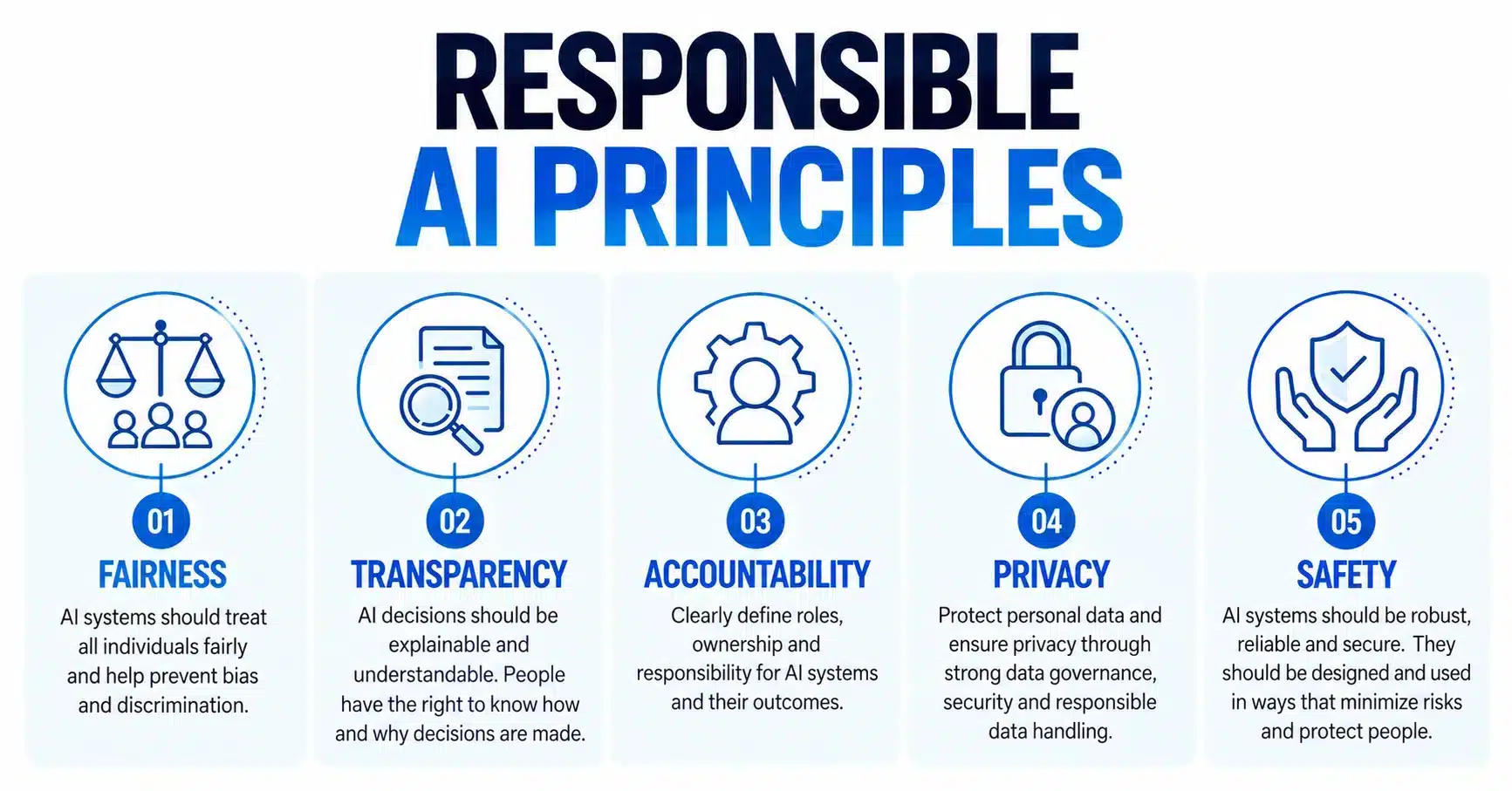
Responsible AI principles are not too difficult to understand, yet holding them together can be challenging. Here’s how:
Fairness vs. Accuracy
It is important to keep in mind that the most accurate model overall may not always be the fairest to all subgroups of people. Training data reflects historical inequalities; therefore, AI models are more likely to reflect them. This is why responsible AI principles exist.
Fairness could mean providing equal opportunity for positive outcomes across different groups, ensuring equal error rates among different groups, or making sure that the system’s decisions match up with actual outcomes experienced by people in different groups. Since it is not easy to achieve all of these at once, choosing which approach to pursue is essentially a value judgment.
Transparency vs. IP and Security
The flip side of having full explainability is that it provides more opportunities for bad actors, but transparency, one of the core responsible AI principles, can be split into separate requirements.
For example, organizations can communicate high-level reasons for model behavior, such as explaining that a customer’s transaction was denied because it took place in an unusual location or exhibited an unusual spending pattern. This does not include details about exact model thresholds or weights. Meanwhile, the organization can still fulfill its regulatory needs around disclosure by providing regulators and other internal audit teams with all the relevant data about how the model works, including the entire model logic and supporting test results.
The rule of thumb is to always explain outcomes to the people impacted and provide details on the internal workings to only those who need to check it against the actual impact.
Accountability vs. Single Point of Failure
While naming an owner may seem like taking responsibility, it can create bottlenecks (a sole point of contact for all decisions) or a scapegoat (the only responsible party, even if someone else’s decision was at fault).
By contrast, programs built around responsible AI principles assign ownership on a per-decision basis. This means that the person signing off on launching a new model is not the same as those monitoring its daily operation or handling outcomes. No single person will be the go-to point of contact to blame if something happens, ensuring there are never any surprises about “who owns this.”
Privacy vs. Model Performance
Minimizing the data a model uses protects privacy, but it’s also one of the fastest ways to break the model that depends on that data for accuracy. Balancing this well is one of the more technical tests of responsible AI principles in practice.
Two effective approaches are:
- Differential privacy ensures a degree of statistical noise is added to the data to prevent leaking an individual’s information, without affecting the patterns needed to train models effectively.
- Federated learning lets you run machine learning models against decentralized datasets on users’ devices instead of having to pull them over. This keeps the underlying data localized and private.
Programs that invest in such methods protect privacy without affecting overall performance.
Safety vs. One-Time Launch Gate
Safety testing does not necessarily end when a model is launched. Ongoing monitoring can help teams identify changes in model behavior as the environment around it changes. For example, a fraud model trained on one year’s transaction patterns can misfire the next year due to changes in spending behavior.
This means a model considered safe on day one can become unsafe after eight months. This is where responsible AI principles earn their value, not as a one-time review before launch, but as continuous monitoring that helps teams catch behavioral drift before it causes real-world harm.
From Theory to Action: Implementing Real-World Responsible AI Practices
Translating the five responsible AI principles into practice comes down to four mechanisms.
Build a Comprehensive AI Inventory
An effective governance program begins with visibility. Maintaining an inventory of AI systems, including their purpose, data sources, business owners and risk classification, helps organizations understand where AI is being used and which systems require oversight. Keeping this inventory current also supports audits, compliance and ongoing governance.
Prioritize Governance Based on Risk
Not every AI system presents the same level of risk. A risk-based approach enables organizations to apply stronger controls to high-impact use cases, such as hiring, healthcare or financial decision-making, while using proportionate oversight for lower-risk applications. Frameworks like the NIST AI Risk Management Framework and the EU AI Act advocate this approach to improve governance without creating unnecessary operational complexity.
Establish Cross-Functional Oversight
Responsible AI requires collaboration across technical, legal, compliance, privacy and business teams. No single function can uphold all five responsible AI principles on its own. Integrating governance reviews at key stages of the AI lifecycle, such as before deployment and during periodic assessments, helps identify risks early, ensures regulatory alignment and strengthens accountability.
Continuously Monitor AI Performance
AI governance does not end at deployment. Models should be monitored for performance, fairness, accuracy and data drift as real-world conditions evolve. Continuous monitoring, supported by defined response processes, such as retraining or human review, helps organizations maintain reliable and trustworthy AI systems over time.
Bridging the Governance Gap With CRAGE
Every tension discussed earlier (fairness versus accuracy, transparency versus security, ownership versus bottlenecks, privacy versus performance, safety as a one-time check versus ongoing discipline) points to the same problem: knowing the responsible AI principles is not the same as being able to operationalize them.
That’s the gap EC-Council’s CRAGE (Certified Responsible AI Governance & Ethics) is built to close. Its methodology follows three stages:
- Assess (identify AI risks, run gap analysis, evaluate governance maturity)
- Govern (design policies, implement controls, establish oversight)
- Sustain (monitor continuously, report on governance metrics)
This maps directly to what this blog walked through: risk-tiered assessment, cross-functional controls and ongoing monitoring instead of a launch-day check.
Practically, it trains GRC managers, CISOs, IT auditors, AI engineers, and privacy officers to build AI governance frameworks, assess AI-specific risk across the model lifecycle, map programs to NIST AI RMF, EU AI Act and ISO/IEC 42001, and coordinate oversight across technical, legal, privacy and risk teams.
As regulation moves from guidance to enforcement, the organizations best positioned are not the ones with the most polished ethics statements but the ones that can produce a governance trail on demand. CRAGE builds exactly that capability.
Frequently Asked Questions
What are responsible AI principles?
Responsible AI principles refer to the foundational set of guidelines and standards that organizations follow to ensure their AI systems are developed and used ethically, transparently, securely and accountably.
What is the difference between responsible AI (RAI) and AI governance?
RAI includes the principles that guide the development and deployment of AI, including fairness, transparency, safety and accountability. AI governance describes an organization’s framework for operationalizing its responsible AI principles through policies, roles, processes and oversight mechanisms.
What are responsible AI best practices?
Best practices for responsible AI include building governance frameworks, assessing AI risks, testing for bias and security issues, ensuring human oversight, protecting data privacy, maintaining transparency and continuously monitoring AI systems post-deployment.
What are the biggest risks of using AI without responsible AI practices?
Some common risks of using AI without responsible AI practices are biased or discriminatory outcomes, privacy breaches, unsafe or unreliable decisions, lack of explainability, regulatory non-compliance and fines, reputational harm (loss of user trust) and challenges in detecting and correcting errors post-deployment.
What are the key principles of responsible AI?
Fairness, transparency, accountability, privacy, safety and human oversight are core responsible AI principles. That means AI systems must be designed to avoid bias, clearly explain their decision-making processes, protect users’ data, ensure security and maintain an overall sense of accountability to humans throughout all development, deployment and monitoring stages.
How can organizations implement responsible AI practices?
Implementing responsible AI requires organizations to establish governance frameworks, conduct bias audits, ensure diverse datasets, enable explainability, train employees, involve cross-functional teams and continuously monitor their AI systems’ fairness, accuracy and regulatory compliance.
Why are responsible AI principles important for enterprises?
By integrating responsible AI principles, organizations can build trust with stakeholders, reduce legal and reputational risks, ensure regulatory compliance and prevent biased or harmful outcomes that could damage their reputation. These principles also help establish stronger customer confidence and enable long-term adoption of AI technologies across business operations.
Reference
IBM. (2025). Cost of a Data Breach Report 2025. https://www.ibm.com/reports/data-breach