AI Enablement: A Practical Guide for Turning AI Experiments into Enterprise Adoption
- AI Program Manager
AI enablement is the strategic process of equipping an organization with the people, processes, technology, and governance to effectively implement, scale, and handle AI initiatives. It means much more than just plugging in AI tools. It requires a structured approach that ensures AI initiatives deliver consistent, meaningful business results.
What Is AI Enablement and How It Differs From AI Adoption and AI Transformation
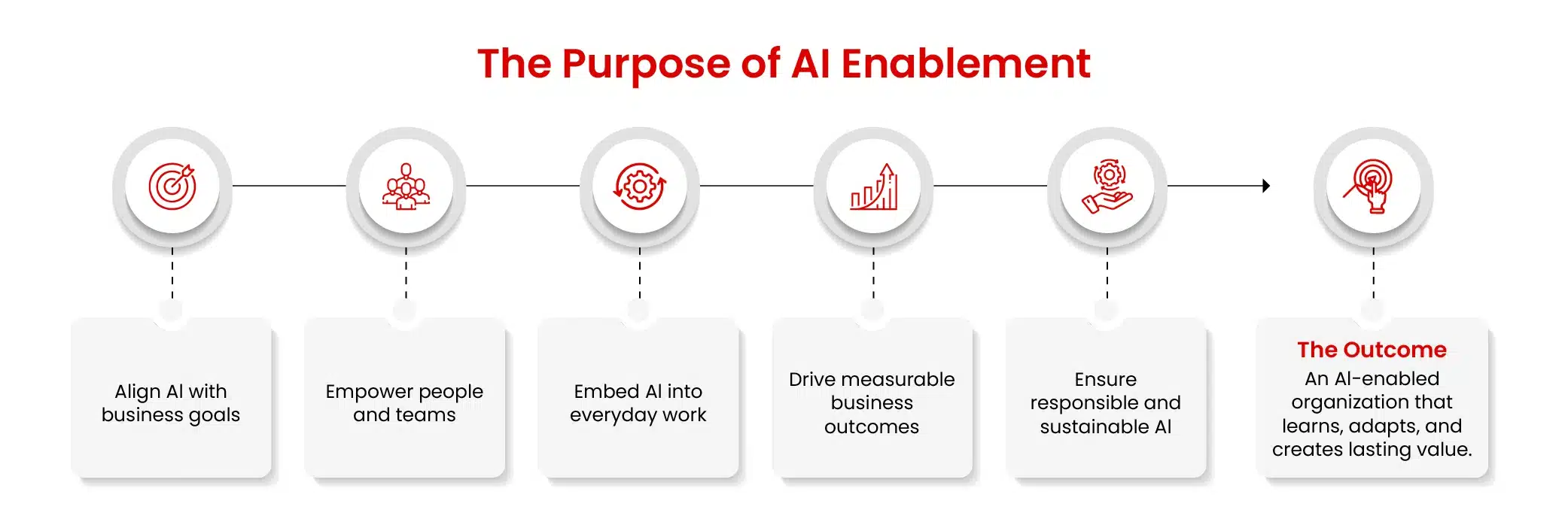
AI enablement means getting every operation and department, including data, governance, workforce, and routine operations, ready to make AI work in reality. In practice, that means:
- Clean and accessible data for the AI model to work effectively
- Policies defining who owns and is accountable if an AI system malfunctions
- Employees who understand the tool and how to use it
- Leaders who have focused on one or two use cases (versus funding 10 random experiments)
Two organizations can adopt the same AI platform and get completely different results. This is because while the AI platform itself matters, effective enablement plays a significant role in helping AI become part of how the business operates, rather than becoming another tool teams quietly stop using after a few months.
AI Enablement vs. AI Adoption vs. AI Transformation
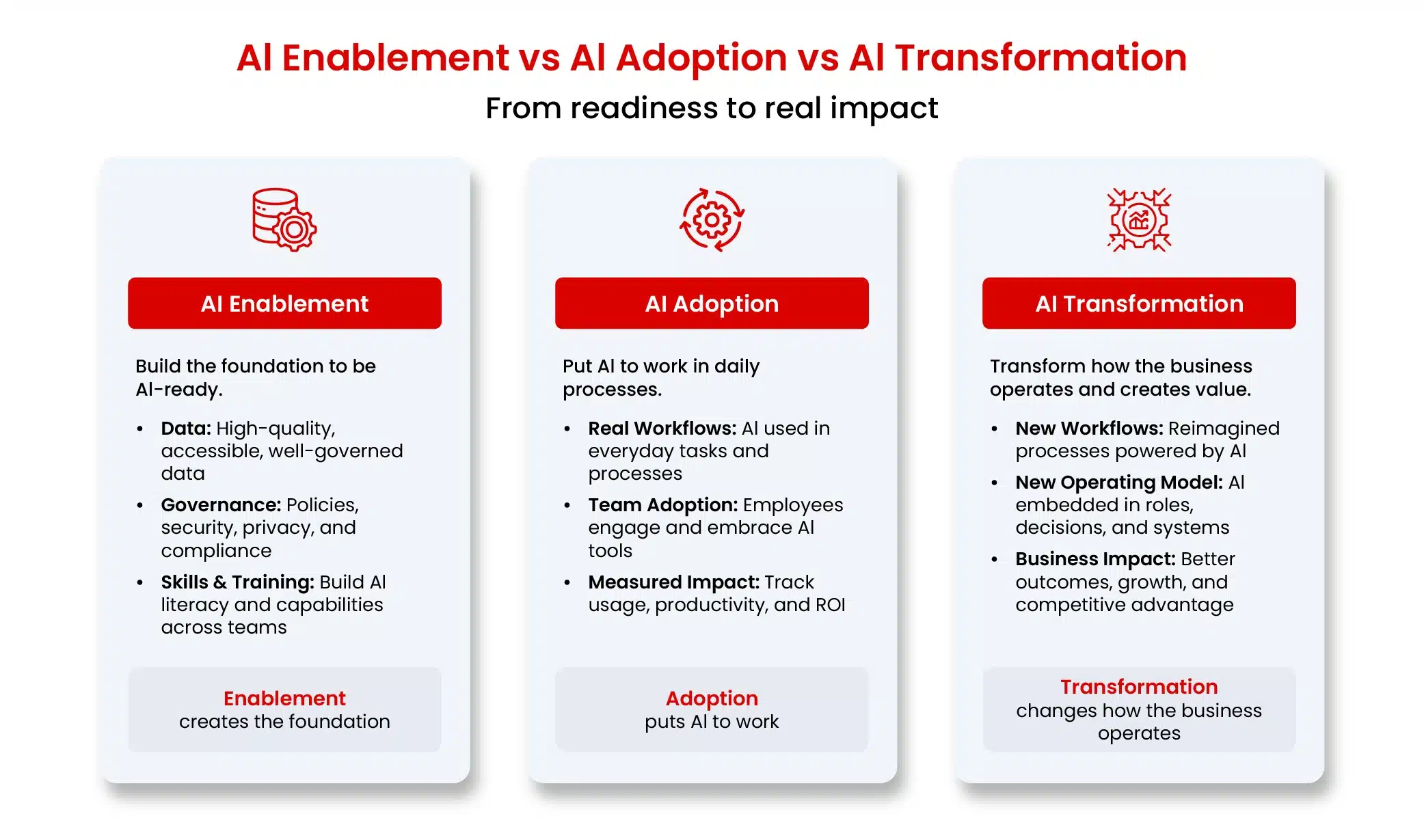
Often used interchangeably, AI enablement, AI adoption, and AI transformation are three entirely different stages happening at three different points in an organization’s AI maturity.
- Enablement builds the foundation and focuses on AI readiness across the organization.
- Adoption is the second step, in which AI is implemented into real workflows (where people incorporate the output into real operations), with someone tracking how often it is right. Note that adoption built without enablement may collapse as soon as you push beyond a small pilot team, because nothing was built to support it at scale.
- Transformation is the final stage after enabling and adopting AI. It describes how an organization has reimagined its business with AI, from overall culture and operating models to critical roles. It gauges enterprise-wide outcomes and shows the long-term gain in strategic change.
Why AI Initiatives Fail Without AI Enablement
Let’s take one of the recent real-world examples to better understand why AI initiatives fail, and it’s not always a “quality-of-AI” issue.
Back in 2025, Deloitte was paid AU$440,000 (about US$290,000) by the Australian government to deliver an assurance review of an Australian welfare compliance system. The published report included fabricated academic citations and quotes, along with a citation of a non-existent book wrongly attributed to a real law professor. After Dr. Christopher Rudge, an Australian welfare academic, spotted the inaccuracies in the published version, Deloitte admitted it had used Microsoft’s Azure OpenAI service to produce the report and updated the incorrect references, emphasizing that the substance and recommendations of the report remained unchanged. The company also agreed to a partial refund (Dhanji, 2025).
Now the question is: What really failed? Was it the governance model or the AI system? Today, generative AI producing inaccurate data is no surprise, making a structured AI enablement program a must to ensure organizations do not repeat similar errors. It is vital to have a review step before delivery, a disclosure policy, and someone with the authority to catch the output before a paying client ever sees it. Enablement is key to supporting AI initiatives and helps prevent them from failing at scale.
How to Build an AI Enablement Strategy: A 6-Step Framework
Everything we discussed till now centered around the what and the why of AI enablement. Let’s now explore what building it looks like.
Here is the AI enablement framework in logical order, because skipping a step won’t just eliminate the work but also create problems that may show up later in the process.
Step 1: Fit AI to the Process, Not the Other Way Around
Before signing off on any tool, it is important to analyze and get an idea of the existing bottleneck.
Is it the slow handoff? Or the reconciliation that the team redoes manually? Or the report drafted from scratch every week? That needs to be fixed first. This is because adding AI to a broken process will only give the same poor results, sometimes even worse.
Step 2: Decide Decision Rights Before AI Deployment
Having clear policies for accountability/ownership is vital. So, this step involves documenting clear policies that define which operations will be AI-assisted, fully automated, or require human approval. Without such policies, every error/inaccuracy ends up blamed on “the AI”, with no one taking responsibility to fix it.
Step 3: Frame AI as a Collaborator, Not a Replacement
Clear communication also plays a vital role in a successful AI rollout. Be intentional about how to introduce AI within the organization. If employees feel AI is going to take their jobs, they will resist or simply ignore using it. But if they see it as a tool implemented to help them work better, they are more likely to adopt it and give valuable feedback.
Step 4: Provide Role-Based AI Training and Back AI with Internal Champions
Avoid a one-size-fits-all AI training that usually gives everyone a broad overview but may not prepare each professional for the real work. Each team should be trained based on how they will be using AI in their routine tasks. Additionally, assign an AI champion in every department, who will answer questions, get feedback, and understand what is working (or not) to refine AI adoption. The observations of these champions can be more beneficial than those occasional company-wide surveys.
Step 5: Let Teams Try Out AI Before Using It for Live Work
Before putting AI into live workflows, give teams an opportunity to try and understand it. This allows people to experiment with different AI use cases, see what’s possible, and find limitations without affecting customers or operations. Once they do that, ask them what worked for them, what didn’t, and most importantly, what they learned. This shared knowledge will help speed up AI adoption in every team by allowing everyone to learn from each other’s mistakes.
Step 6: Measure Outcomes, Not Activity
Metrics like login counts only tell you people are using your tool; they don’t prove it is making an impact. To learn that, focus on business outcomes like reduced cycle time, lower error rates, higher resolution volume, or improved productivity. These will reveal if the AI enablement was effective and added meaningful value for your business. In the next section, we cover the key metrics that every organization should track.
How to Measure AI Enablement Success
A practical way to understand the success of an AI enablement strategy is by examining the overall performance of the business, the efficiency of routine operations, workforce adoption, and governance. These four areas give a holistic view of the strengths and weaknesses of AI initiatives.
Business Metrics: Is AI Delivering Business Value?
These metrics evaluate if your AI efforts are bringing about a noticeable impact on your strategic and financial goals.
- Return on Investment (ROI): Compare the value produced by AI initiatives against implementation and operational expenses.
- Cost Reduction: Measure cost savings from automating processes, reducing manual effort, or cutting down operational expenses.
- Revenue Growth: Track revenue achieved from AI-enabled products, services, enhanced customer experiences, or more sales opportunities.
Operational Metrics: Is AI Improving How Work Gets Done?
Operational metrics consider how AI affects efficiency and execution.
- Time Saved: Measure improvements in the amount of time taken to perform repetitive or time-consuming tasks.
- Workflow Automation: Assess the percentage of business processes that have been successfully automated or augmented using AI.
- Productivity: Analyze how your output improved, whether you increased product throughput, and whether service delivery was faster or more efficient than before.
People Metrics: Are Employees Adopting AI Effectively?
These metrics help determine whether AI made a difference to the workforce and whether the workforce is using it confidently.
- Adoption Rate: How often is your workforce using AI tools?
- AI Literacy: Assess if they are well-versed in AI capabilities, limitations, and responsible usage through training completion, assessments, or certifications.
- Employee Engagement: What are their levels of satisfaction, confidence, and likelihood to use AI in daily routine tasks?
Governance Metrics: Is AI Being Used Responsibly?
Consider the below metrics to help ensure AI is used securely and responsibly.
- Policy Compliance: Ensure compliance with internal AI governance policies, regulatory requirements, and responsible AI guidelines.
- Model Performance: Continuously evaluate how well your governance model is doing to ensure AI performs as expected: are AI predictions accurate? Is AI output reliable? Has there been a drift, or are the results inconsistent?
- Risk Incidents: Quantify the occurrence of AI problems like hallucinations, bias, security breaches, privacy violations, or compliance failures to identify where stronger governance is required.
The Skills Gap Behind AI Enablement Failures and Where CAIPM Fits
AI enablement is not one person’s responsibility. Executives hold the budget, business leaders own the AI operational workflows, data teams keep the infrastructure usable, and AI specialists manage the deployed AI systems, but none holds the whole thing together. That is the exact gap Deloitte’s report fell through: end-to-end human accountability for AI-produced work. This is where the role of AI program management in enablement of AI initiatives becomes crucial. It closes that gap by coordinating cross-functional AI efforts and ensuring security, governance, and compliance-led integration.
This requires a blend of AI program management skills, including:
- Understanding enough AI fundamentals to recognize where AI is likely to be wrong.
- Building governance into the process early instead of adding it after problems appear.
- Measuring ROI rigorously enough to prove a pilot deserves to scale or to justify shutting it down.
EC-Council’s Certified AI Program Manager (CAIPM) is the best way to build these skills. The program has a dedicated module on change management and AI enablement, covering application of ADKAR and Kotter frameworks specifically to AI rollouts, design of AI training programs, and more. The focus of the certification is to prepare professionals to bridge AI strategy, governance, and execution as AI program managers, a role that is becoming crucial in helping AI initiatives scale.
Conclusion
Every section of this guide comes back to the same fact: the organizations stuck on the wrong side of AI’s adoption-without-value gap aren’t missing access to the technology. They are missing the structure around it: the governance that catches a bad output before a client sees it, the roadmap that gives a pilot a real shot at scaling past one team, and the evolving role of AI program managers whose job is to connect strategy to execution instead of assuming someone else has it covered.
The future of AI enablement will not be defined by better AI systems alone. It will also require treating AI enablement as actual infrastructure, which is built deliberately, owned by named people, and measured on outcomes instead of activity. This discipline is more vital when buying an AI tool or announcing an AI initiative. Also, if there is one place to start, start with the readiness assessment described in step 1 of the 6-step AI enablement framework above. It is not the most exciting step, but every step after it inherits whatever gap the readiness assessment leaves unresolved.
FAQs
Why AI enablement matters?
AI enablement helps organizations move from isolated AI experiments to building the capabilities needed for adopting, governing, and scaling AI initiatives across the enterprise. It connects technology with business strategy, workforce readiness, and governance to improve adoption, reduce risk, and deliver meaningful business value.
What are the core components of enterprise AI enablement?
Enterprise AI enablement typically includes AI strategy, organizational readiness, governance, AI literacy, use case prioritization, technology integration, change management, and performance measurement. Together, these components help organizations implement AI effectively while ensuring the AI system remains secure, compliant, and aligned with business objectives.
What are some practical uses of AI in business?
Businesses use AI to automate repetitive tasks, analyze large datasets, improve customer support, personalize marketing, detect fraud, optimize supply chains, assist with software development, enhance decision-making, and generate content. The most valuable use cases solve specific business problems and deliver measurable operational or financial outcomes.
What are the challenges in AI enablement?
Common AI enablement challenges include limited AI skills, poor data quality, unclear business objectives, weak governance, employee resistance to change, integration with legacy systems, and difficulty measuring business impact. Addressing these challenges requires a structured strategy that balances technology, people, and governance.
References
Dhanji, K. (2025, October 06). Deloitte to pay money back to Albanese government after using AI in $440,000 report. The Guardian. https://www.theguardian.com/australia-news/2025/oct/06/deloitte-to-pay-money-back-to-albanese-government-after-using-ai-in-440000-report