Last Updated : July 02, 2026 |
Pappu Mandal |
Executive Management
A chief technology officer (CTO) is a senior executive responsible for an organization’s technology strategy and execution, tasked with building and managing the organization’s technology capabilities while ensuring those capabilities support overall business objectives. Reaching this executive position requires strong technical expertise, proven leadership experience, and the strategic thinking necessary to lead an organization’s technology vision.
The Growing Importance of the CTO Role
Today, businesses across industries depend heavily on technology systems and strong network infrastructure. This increased reliance on technology has led to a critical demand for effective leadership, particularly in the role of chief technology officer.
The CTO typically oversees an organization’s technology strategy and initiatives. These responsibilities may include information technology (IT) and data management, developing technical strategies to enhance business operations, leading technology teams, and collaborating with stakeholders to drive innovation and improve the customer experience. Furthermore, chief technology officers play a crucial role in promoting a security-by-design approach, in which security considerations are integrated from the beginning of product development, and in supporting shift-left security, which moves security testing and validation earlier in the development life cycle.
As advancements in IT accelerate due to the impact of technologies such as artificial intelligence (AI), the need for computer and information systems managers, an occupational category that includes CTOs and other senior technology leadership roles, is projected to increase by 15% from 2024 to 2034 (U.S. Bureau of Labor Statistics, 2026). This is possibly due to the need for leadership skills to innovate, plan, and manage technology capabilities augmented by artificial intelligence (AI) and machine learning (ML). Given the seniority and strategic importance of the position, compensation is also substantial. The average CTO salary in the United States is $309,609 per year, with top earners reaching $379,770 and entry-level roles starting at $256,820 (Salary.com, 2026).
By 2026, over 90% of organizations globally are projected to feel the impact of IT skills shortages (Smith & Loomis, 2024). This suggests that the corporate landscape is experiencing a significant surge in demand for skilled technology leaders, driven by rapid technological advancements and persistent skills gaps. The growing demand for skilled chief technology officers and other technology leaders calls for organizations to implement proactive strategies to attract, nurture, and retain top talent. Addressing these challenges allows organizations to develop a skilled workforce that can advance their technology capabilities and sustain a competitive edge.
The Roles and Responsibilities of the CTO
The role is both pivotal and multifaceted, encompassing the oversight of hardware, software, data, and networks, as well as the development of technology solutions for customers, internal users, or business stakeholders, depending on the organization. Anyone reviewing a typical CTO job description will notice that the skills needed to execute these responsibilities effectively, including technical, managerial, and interpersonal skills, are equally important.
Key Responsibilities of the CTO
- Strategic Technology Planning: Developing and implementing a comprehensive technology strategy that aligns with business objectives by defining the roadmap and identifying relevant technology trends.
- Innovation and Market Research: Researching emerging technologies and developing technological solutions that align with market trends and support technology adoption to improve business operations.
- Technology Team Leadership: Leading technology teams through the process of product development, implementation, and testing.
- Talent and Workforce Management: Managing workforce development through hiring, mentoring, and ensuring effective teamwork.
- Reliability and Compliance Assurance: Ensuring reliability through product testing and compliance with applicable standards and regulations while maintaining a high level of infrastructure availability.
- Budgeting and Resource Allocation: Developing a budget plan and managing resource allocation for various hardware, software, and workforce-related needs to ensure cost-effectiveness.
- Disaster Recovery and Business Continuity Planning: Developing and testing disaster recovery and business continuity plans for potential security incidents, outages, or disasters.
- Risk and Vulnerability Management: Managing the process of identifying and mitigating risks and vulnerabilities to support data privacy, security, and compliance.
- Security-Driven Development Policies: Developing and implementing software development policies that are security-driven and incorporate security requirements from the initial stages of development.
- Security-by-Design: Implementing and ensuring security-focused product design during the initial stages of development.
- Cross-Functional Collaboration and Stakeholder Management: Collaborating with business leaders, technology and security vendors, and other executives to clarify the organization’s requirements and guide strategic business decisions. Together, these responsibilities show why the CTO must combine technical depth, business judgment, and leadership discipline.
Key Skills Required for the CTO Role
The position requires a broad range of skills, which can be grouped into technical expertise, leadership and management, vision and innovation, and business and financial acumen. Relevant CTO training or an executive technology leadership certification can help aspiring CTOs develop and validate these competencies, including the ability to ensure effective communication between different business functions across the organization.
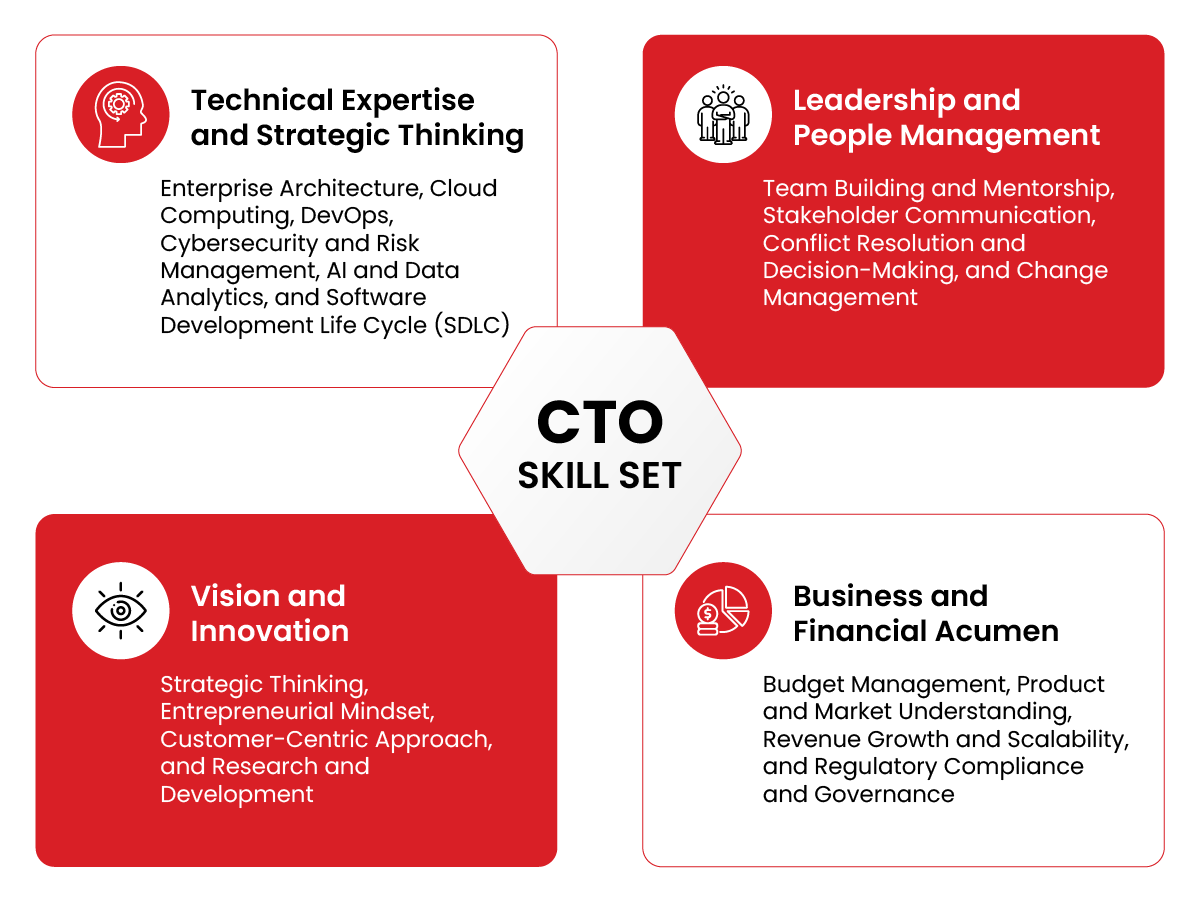
- Technical Expertise: Effective technology leadership requires in-depth knowledge of various technologies, including software development, networking, cloud computing, data analytics, and security. As a result, extensive education in fields such as IT, computer science, emerging technologies, and business administration is generally expected, while relevant professional certifications and advanced technical credentials may be preferred or required, depending on the organization. Expertise in domains such as data science, information technology, software development, cybersecurity, cloud computing, AI, and blockchain is also highly valued.
- Leadership and Management: A proven track record of large-scale technology project development and management experience is essential. Beyond technical expertise, the position also demands the ability to lead and motivate teams while building a strong work environment. Also, since the role serves as a crucial common point of connection between various teams and leaders, excellent communication and interpersonal skills are essential for effective collaboration and workflow.
- Vision and Innovation: Another key skill is identifying emerging technologies, evaluating their business potential, and guiding innovation in a way that supports long-term organizational goals. This includes strategic thinking, research and development, and a customer-centric approach to technology adoption.
- Business Acumen and Critical Thinking: With constantly changing business needs and an evolving technology landscape, technology leaders must be agile and have the ability to think strategically, solve problems, and understand business principles, financial metrics, and market trends. This enables the organization’s technology infrastructure to adapt to emerging trends and changes.
Career Path for Aspiring CTO Candidates
A CTO is an executive with advanced technical expertise and proven experience in both technology and management domains. Reaching this position requires continuous learning and skill development. For professionals mapping out how to become a CTO, the key steps to charting this career path, along with the core CTO requirements, can be outlined as follows:
Educational Foundation
The journey begins with earning a degree in relevant fields such as computer science, information technology, or software engineering. Advanced degrees or additional education in business, finance, or economics can also be beneficial for developing management skills. Among surveyed CTOs, approximately 34.1% hold a Master of Science degree, 28.6% have a Bachelor of Science degree, and 6.6% have earned a PhD. Beyond formal education, 47.3% of surveyed technology leaders have taken online courses (STX Next, 2025).
Gaining Technical Expertise
Developing in-depth expertise in specialized areas of IT, such as cloud computing, data analytics, artificial intelligence, blockchain, cybersecurity and risk management, enterprise architecture, DevOps, software development, or the SDLC, is critical. This can be achieved through work experience, CTO certificate programs, online CTO courses, and continuous learning.
Managerial Skills and Experience
Hands-on experience in both technical and managerial roles is essential. Leading teams, managing cross-functional collaboration, and aligning technology initiatives with business requirements allow aspiring chief technology officers to develop the skills and abilities needed to integrate technical capabilities with strategic objectives.
Building a Professional Network
Building connections with peers across the industry can help professionals understand the current market and identify suitable career opportunities. Similarly, establishing connections with technology leaders and vendors builds business relationships, enabling the organization to support business growth.
Transitioning from a technical leader to a CTO involves shifting from a technology specialist position to a broader leadership position with a strategic mindset. While technical skills provide a strong foundation, success also depends on developing business acumen, strategic thinking, and leadership capabilities.
Importance of Cybersecurity Management for CTOs
Developing and implementing robust IT security policies is an important responsibility for this executive role, often in collaboration with a chief information security officer (CISO), security teams, and other technology leaders, to protect the organization’s IT infrastructure. With the growing need for proactive security measures, technology leaders must integrate security capabilities into the technology strategy and IT architecture from the earliest stages.
This involves close collaboration with cybersecurity experts to design and enforce policies that safeguard IT assets and support compliance with data privacy and digital security regulations. Key efforts include encryption, network security, threat detection, data protection, and incident response protocols.
Example: The Marks & Spencer Cyberattack and Business Continuity
A major cyberattack on Marks & Spencer in April 2025 led to the loss of some personal customer data, including contact information, date of birth, and online order history. Although no card details or account passwords were compromised, the attack affected the company’s core operations. M&S paused online orders in late April and announced that services would not return to normal until July. By June 10, 2025, only a limited range of fashion products had been restored for online ordering, and even then, only for customers in England, Wales, and Scotland. Delivery times were also extended to 10 days to manage demand, while click-and-collect remained suspended (BBC, 2025).
This example shows why cybersecurity management is a strategic responsibility for technology leaders. Strong security policies, secure-by-design technology planning, incident response capabilities, and business continuity planning are essential to protecting both digital infrastructure and customer trust.
The CTO’s Role in Cybersecurity Response
As the role also involves overseeing software, IT development, and management processes, their active involvement in cybersecurity ensures seamless integration and effective management of security measures. In cybersecurity response, the CTO responsibilities can be classified into:
Prioritization: This involves risk assessment, classification, scanning, threat intelligence, impact analysis, and related activities.
Response: This involves responding to threats through incident detection, alerting, escalation, containment, and communication.
Remediation: This involves finding the root cause, patching, updating, restoration, awareness, training, system hardening, and related corrective actions.
Additionally, the role demands staying updated on emerging technological and cybersecurity trends to enhance the organization’s IT infrastructure and business operations while mitigating potential security threats.
Cybersecurity Management Essentials for Technical Professionals
In today’s rapidly evolving threat landscape, a CTO plays a key role in integrating cybersecurity into technology strategy, IT operations, and product development while aligning these efforts with the organization’s broader business goals. Bridging the gap between technical expertise and business strategy requires a well-defined framework based on the following core principles:
Align Security with the Organizational Mission
Ensure cybersecurity measures protect IT assets while maintaining a positive user experience, and aligning with the organization’s mission and goals.
Adopt a Risk-Based Approach
Use a risk-based approach to integrate cybersecurity with IT and address the most critical threats to business operations.
Foster Cross-Department Collaboration
Encourage collaboration across departments to ensure a holistic and comprehensive implementation of cybersecurity measures.
Effectively Communicate Cybersecurity Risks
Clearly and regularly communicate risks to non-technical stakeholders, emphasizing the business impact of threats to gain support and drive action.
Utilize Metrics for Insights
Establish frameworks that provide metric-based insights into IT and security performance, using them to deliver actionable recommendations for improving infrastructure and strengthening security posture.
Evaluate the ROI of Cybersecurity Initiatives
Assess the return on investment (ROI) of IT and cybersecurity projects to ensure optimal allocation of resources, risk reduction, and business value.
Support Innovation and Digital Transformation
Drive innovation and digital transformation initiatives, ensuring security is a key enabler of business growth and operational efficiency.
Promote a Security-Aware Culture
Embed cybersecurity into the organization’s culture by promoting employee training, awareness programs, and secure practices across all levels of the organization.
CCISO: A Strategic Cybersecurity Leadership Program
Cybersecurity is a critical component of technological development and operations, making it essential for technology executives to prioritize it. The cybersecurity skills gap continues to widen, with two in three organizations reporting moderate-to-critical skills shortages, while only 14% are confident they have the cybersecurity talent and skills required (World Economic Forum, 2025). Therefore, for a CTO to strengthen their cybersecurity leadership capabilities, a structured program like CCISO can help build both technical and managerial expertise.
The Certified Chief Information Security Officer (CCISO) program, developed by EC-Council, is designed for technology and cybersecurity professionals preparing for executive leadership roles. It equips candidates with the leadership skills, technical expertise, and strategic knowledge necessary to manage and secure an organization’s information assets while aligning cybersecurity initiatives with business objectives.
Key Features of the CCISO Program
Comprehensive Curriculum: The program provides a deep dive into governance, risk management, incident response, and compliance, blending technical knowledge with business leadership principles.
Cybersecurity Management for Leadership: CCISO teaches professionals how to align cybersecurity strategies with business goals, adopt a risk-based approach, and drive decision-making at the executive level. It emphasizes effective communication with stakeholders, translating technical risks into business impact for informed decision-making.
Building a Professional Network: Through CCISO, participants gain access to a global community of experienced cybersecurity professionals, fostering networking opportunities and peer collaboration.
Validating Expertise: Earning the CCISO certification demonstrates advanced knowledge, experience, and leadership capabilities, helping candidates validate their expertise in the field.
Together, these features support professionals as they prepare to lead technology and security initiatives more effectively.
FAQs
What is a chief technology officer (CTO)?
What are the key responsibilities of a chief technology officer?
Key responsibilities include formulating technology strategies, leading engineering teams, managing product development, assessing new technologies, improving technical operations, and overseeing cybersecurity priorities. They work with business executives to promote innovation and growth, manage technology budgets, and maintain efficient technological systems.
What qualifications do you need to become a chief technology officer?
A CTO qualification typically includes expertise in computer science, engineering, information technology, or related domains. Many also have a bachelor’s or master’s degree, in addition to extensive experience in software development, management, and technology management.
How long does it take to become a CTO?
Becoming a CTO can take 10 to 20 years of progressive experience in IT, software development, engineering, or technology leadership roles. This includes years of education, hands-on experience, and leadership experience.
What skills are essential for a successful chief technology officer?
Essential skills for a chief technology officer include leadership, strategic thinking, technical expertise, communication, project management, cybersecurity awareness, and the ability to align technology with business goals.
Is cybersecurity knowledge important for a CTO?
Yes, cybersecurity training is useful for gaining knowledge of security, networking, risk management, and technology protection practices. However, a CTO job generally demands broader experience in software development, infrastructure, management, and strategic planning. Combining cybersecurity expertise with technical and management skills is important.
Can a cybersecurity degree help you become a chief technology officer?
References
BBC. (2025, June 10). What Can I Buy Online at M&S Since the Hack. https://www.bbc.com/news/articles/c0el31nqnpvo
Salary.com. (2026, June 1). Chief Technology Officer Salary in the United States. https://www.salary.com/research/salary/benchmark/chief-technology-officer-salary
Smith, G., & Loomis, A. (2024, May 20). Skills, AI and the Enterprise: Three Strategies for the Road Ahead. IDC. IDC – Skills, AI and the Enterprise: Three Strategies for the Road Ahead
STX Next. (2025). The Global CTO Survey 2025 Report – AI Edition. https://4542168.fs1.hubspotusercontent-na1.net/hubfs/4542168/the-cto-survey-2024-25(ai)/TheCTOSurvey2024-25.pdf
U.S. Bureau of Labor Statistics. (2026, May 27). Computer and Information Systems Managers. https://www.bls.gov/ooh/management/computer-and-information-systems-managers.htm
World Economic Forum. (2025). Global Cybersecurity Outlook 2025. https://reports.weforum.org/docs/WEF_Global_Cybersecurity_Outlook_2025.pdf

Pappu Mandal