
Articles

2026

AI Threat & Risk Management: Adversarial Testing, Red Teaming & Supply Chain Security

As artificial intelligence (AI) transitions from experimentation to enterprise-scale deployment, organizations are increasingly integrating AI into customer engagement, analytics, decision support, automation, and operational workflows. While these capabilities offer significant business value, they also introduce new categories of risk that extend beyond traditional cybersecurity concerns. Unlike conventional software systems, artificial intelligence models operate probabilistically, rely…

Read article
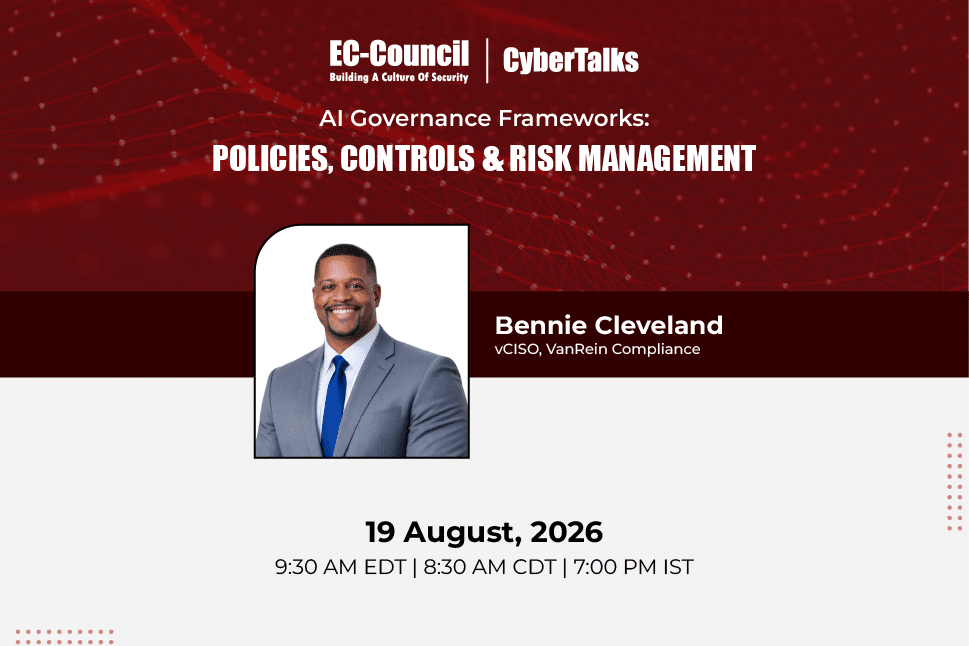

AI Governance Frameworks: Policies, Controls & Risk Management

Date: August 19, 2026 Time: 9:30 AM EDT | 8:30 AM CDT | 7:00 PM IST Topic: AI Governance Frameworks: Policies, Controls & Risk Management Watch Now Abstract: Many organizations understand the importance of AI governance, but struggle to translate high-level principles into practical, enforceable frameworks. Disconnected policies, unclear ownership, and lack of structured controls…

Read article
CCSE Cloud
What is Cloud Security?

Cloud security comprises all the policies, controls, and technologies necessary to protect cloud-based systems, data, and infrastructure against unauthorized access, breaches, and other threats. With increasing numbers of businesses moving their most mission-critical workloads into the cloud, knowing how to securely navigate in and respond to incidents within this environment is paramount. Cloud Security in…

Read article
AI Enablement: Turning AI Experiments into Enterprise Adoption

AI Enablement: Turning AI Experiments into Enterprise Adoption AI enablement is the strategic process of equipping an organization with the people, processes, technology, and governance to effectively implement, scale, and handle AI initiatives. It means much more than just plugging in AI tools. It requires a structured approach that ensures AI initiatives deliver consistent, meaningful…

Read article
Trust but Verify: Human Oversight in AI-Powered Financial Security

Date: August 18, 2026 Time: 5:00 AM AST | 10:00 AM EDT | 7:30 PM IST Topic: Trust but Verify: Human Oversight in AI-Powered Financial Security Watch Now Abstract: Artificial intelligence is transforming financial security by enabling organizations to detect fraud faster, automate compliance monitoring, identify anomalous transactions, and respond to threats in real time.…

Read article
AI adoption business strategy
The AI Adoption Business Strategy Enterprises Need

The AI Adoption Business Strategy Enterprises Need AI adoption refers to the integration of artificial intelligence into organizational operations, decisions, and workflows. Without a clear adoption plan, an organization’s efforts often remain stagnant at the pilot level. The AI projects are able to deliver on promises made during demos but fail to achieve scalable transformations…

Read article
Purple Teaming in Cybersecurity: Significance, Roles, Tools, and Challenges

Purple Teaming in Cybersecurity: Significance, Roles, Tools, and Challenges Purple teaming is a collaborative cybersecurity approach where red team attackers and blue team defenders work together in a continuous feedback loop to test, identify, and strengthen an organization’s security posture. This article explores everything you need to know about it, from how it works, why…

Read article
Prompt Injection: Understanding AI Security Vulnerabilities

Date: August 13, 2026 Time: 8:30 AM CDT | 9:30 AM EDT | 7:00 PM IST T Topic: Prompt Injection: Understanding AI Security Vulnerabilities Watch Now Abstract: Large Language Models (LLMs) are rapidly transforming business operations, software development, customer engagement, and cybersecurity workflows. However, as organizations increasingly integrate AI-powered applications into their environments, new attack…

Read article
Network Penetration Testing Explained: Methods, Benefits, and Key Steps

Network penetration testing is the practice of simulating real-world cyberattacks against an organization’s network to find security weaknesses before malicious actors can exploit them. Despite having security systems in place, organizations still experience network penetration incidents such as information leaks, unauthorized access to network systems, and data loss. In some cases, these incidents could have…

Read article